
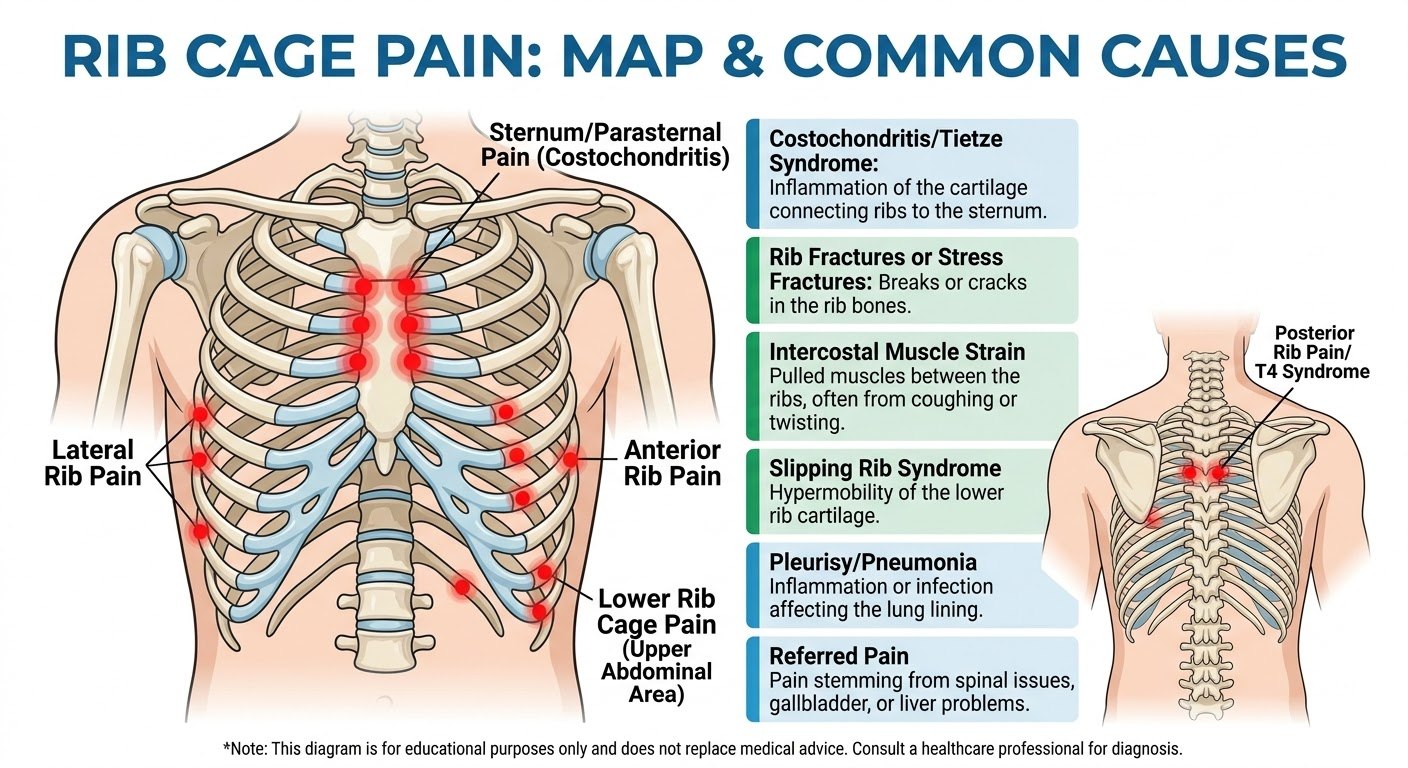
Chest pain is frightening. If you have searched for where costochondritis hurts, there is a good chance you have been pressing on a sore spot near your breastbone and trying to work out whether it is something serious.
This guide covers where costochondritis pain typically shows up, what it feels like, why it affects women more often, and — importantly — the symptoms that mean you should stop reading and seek urgent medical assessment instead.
What costochondritis actually is
Your ribs do not attach directly to your breastbone. They connect through short bands of cartilage. Costochondritis is inflammation of that cartilage, most often at the joints where the ribs meet the sternum.
It is a common cause of chest wall pain, and in the large majority of cases it is benign and self-limiting. It is not a heart condition and it does not damage the lungs. But because it produces pain in the chest, it is understandably alarming.
Where costochondritis pain is felt
This is the part most people are searching for. The pain follows a fairly consistent pattern.
The main area — alongside the breastbone. Pain sits along one or both edges of the sternum, most commonly across the second through fifth ribs. Many people can put a fingertip on the exact sore spot, which is one of the more distinctive features of the condition.
One side or both. It is often felt on the left, which is part of why it gets mistaken for cardiac pain. It can occur on the right or on both sides.
Referred pain — shoulder, mid back, and between the shoulder blades. The pain does not always stay at the front. Because the ribs wrap all the way around to the spine, irritation at the front can be felt as an ache in the shoulder, the mid back, or between the shoulder blades. People sometimes arrive convinced they have a back problem when the source is at the front of the chest.
Pain that moves with you, not with exertion. Costochondritis pain typically changes with position and movement — twisting, reaching overhead, lying on that side. This is a meaningful distinction from cardiac pain, which more often relates to exertion.
What it feels like
- Sharp, aching, or a deep pressure-like sensation
- Worse when you press directly on the spot — this reproducibility is characteristic
- Worse with deep breathing, coughing, sneezing, or laughing
- Worse with twisting, reaching, pushing, or pulling
- Often eased by rest and shallow, quiet breathing
Pain that you can reliably reproduce by pressing on a specific point is one of the strongest hints that the problem is in the chest wall rather than inside the chest. It is a hint, though, not a diagnosis.
Why costochondritis is more common in women
Costochondritis is reported more frequently in women than in men, and it becomes more common after around age 40.
This matters for a second reason. Women’s cardiac symptoms are more likely to present in ways that do not match the familiar picture of crushing central chest pain. Fatigue, nausea, breathlessness, and jaw or back pain can all feature. So while costochondritis is more common in women, the importance of ruling out cardiac causes is, if anything, greater — not lower.
When chest pain is not costochondritis
Please treat this section as the most important part of the page.
Seek urgent medical care if chest pain comes with any of the following:
- Pain brought on by exertion and relieved by rest
- Spread to the jaw, neck, left arm, or both arms
- Nausea, vomiting, or cold sweat
- Shortness of breath out of proportion to your activity
- Light-headedness, fainting, or palpitations
- Unusual, overwhelming fatigue
- Coughing up blood, or sudden breathlessness after a long flight, surgery, or period of immobility
- Fever, unexplained weight loss, or a history of cancer
None of these are features of costochondritis. If any apply, go to an emergency department. A rib diagnosis found online is not worth the risk of missing a cardiac event or a pulmonary embolism.
What causes it
There is not always a clear trigger, but the common contributors are mechanical and repetitive rather than dramatic:
- Repeated minor strain — heavy or unfamiliar lifting, pressing movements, rowing, or a sudden increase in training volume
- Prolonged coughing — a lingering respiratory infection puts the chest wall through thousands of forceful contractions
- Sustained posture load — long hours in a rounded upper back with the shoulders drawn forward, which compresses the front of the chest and restricts normal rib movement
- Direct impact — a fall, a seatbelt in a collision, or contact sport
Costochondritis or Tietze syndrome?
These are related but not identical. Tietze syndrome involves visible or palpable swelling at the affected joint, usually at a single site near the second or third rib, and tends to occur in younger people. Costochondritis affects multiple sites and produces tenderness without visible swelling. Tietze syndrome is considerably rarer.
How long it lasts and what helps
Most cases settle over several weeks. Some run longer — a few months is not unusual, and a minority persist further. It resolves in the great majority of cases.
What generally helps:
- Relative rest — reduce the movements that reproduce the pain, without stopping activity altogether
- Time — this is genuinely the main treatment, however unsatisfying that sounds
- Heat over the sore area for symptom relief
- Gentle breathing work — many people start guarding and breathing shallowly, which stiffens the chest wall further
- Pain relief — discuss options with your doctor or pharmacist
If pain has not improved after four to six weeks of conservative management, see your doctor. Further assessment or a local injection may be considered.
Where chiropractic care fits — and where it does not
I want to be straightforward here, because there is a lot of overclaiming in this area.
Chiropractic care does not cure costochondritis. The inflammation resolves on its own timeline. The evidence base for manual therapy in costochondritis specifically is limited.
What it can address are the mechanical contributors, where those exist. If your ribs and mid back have become stiff, if your posture is loading the front of your chest through long working hours, or if you have been guarding and breathing shallowly for weeks, those are modifiable, and they are what we work on — through thoracic and rib mobility work, chiropractic adjustment, breathing mechanics, and changes to how you sit, lift, and train.
If your presentation does not look mechanical, or if anything in the red-flag list above appears, the right answer is a referral, not a treatment plan. That is how we handle it.
Frequently asked questions
Where exactly does costochondritis hurt?
Along the edges of the breastbone, usually across the second to fifth ribs. It can be one side or both, and it can refer to the shoulder, mid back, or between the shoulder blades.
Can costochondritis cause back pain?
Yes. Because the ribs wrap around to the spine, front-of-chest irritation is often felt in the mid back or between the shoulder blades.
Can bad posture cause costochondritis?
Posture alone is rarely the sole cause, but sustained rounded-shoulder positions restrict normal rib movement and load the chest wall, which can contribute to it developing and to it persisting.
How do I tell costochondritis from a heart problem?
Costochondritis pain is usually reproducible by pressing on a specific spot and changes with movement and breathing. Cardiac pain is more often linked to exertion. This is a guide, not a test. If you are unsure, get assessed.
How long does costochondritis last?
Commonly a few weeks to a few months. If it is not improving after four to six weeks, see your doctor.
Is costochondritis more common in women?
Yes, it is reported more often in women, and more often after age 40.
This article is general information, not medical advice, and does not replace assessment by a qualified clinician. If you are experiencing chest pain, seek medical attention.
Eugene Gan, Chiropractor
Chiropractic House, Segambut, Kuala Lumpur
Book an assessment · @chirohousekl on Instagram


