
For most healthy adults with mechanical back or neck pain, chiropractic care carries a low risk of serious harm — but it is not risk-free, and it is not right for everyone. Mild soreness afterwards is common. Serious complications are rare. The bigger safety issue, in practice, is not the adjustment itself; it is being treated for pain that should have been sent to a doctor in the first place.
That is the honest version, and worth understanding before you book anything.
The side effects most people actually get
The overwhelming majority of adverse effects from spinal manipulation are mild, short-lived, and self-resolving. A 2017 review of around 250 scientific publications, summarised by the US National Center for Complementary and Integrative Health (NCCIH), found that transient mild-to-moderate side effects — increased pain or discomfort, stiffness, or headache — often occur after spinal manipulation or mobilisation, and that most of these resolve within 24 hours.
| What you might feel | How common | How long it usually lasts |
|---|---|---|
| Local soreness or aching, like after a workout | Common | Under 24 hours |
| Stiffness in the treated area | Common | Under 24 hours |
| Headache | Less common | Under 24 hours |
| Tiredness | Less common | Same day |
| Serious spinal, neurological or vascular injury | Very rare — no accurate incidence estimate exists | Requires urgent medical care |
That last row deserves attention rather than a footnote. NCCIH is explicit that serious side effects, including serious spinal or neurological problems and strokes involving arteries in the neck, have been reported, that they are very rare, and that there are no accurate estimates of how often they occur. Anyone who quotes you a precise risk figure is quoting something the evidence does not support.
The neck manipulation and stroke question
This is the concern most people have actually read about, so it deserves a direct answer rather than a reassurance.
Manipulation of the neck has been linked to cervical artery dissection — a small tear in the wall of an artery in the neck, which can lead to a stroke. What remains genuinely unsettled is whether manipulation causes these tears or whether people who are already developing one seek treatment for the neck pain and headache the tear is producing. NCCIH’s position is that the incidence in people receiving spinal manipulation is low, that there is disagreement about whether manipulation can actually cause a dissection, and that patients should be informed of the potential risk regardless.
Sudden neck movements of many kinds — sports, whiplash, violent coughing or vomiting — have also been associated with these tears. That context matters, but it is not a reason to wave the question away. If you would rather not have your neck manipulated, say so. Neck pain can be managed with mobilisation, soft tissue work and exercise, none of which involve a thrust technique.
Red flags — see a doctor, not a chiropractor
Some symptoms mean your problem is not a mechanical one, and manual therapy is not the answer. If any of the following apply, seek urgent medical assessment at a hospital or with a doctor. Do not book a chiropractic appointment and wait.
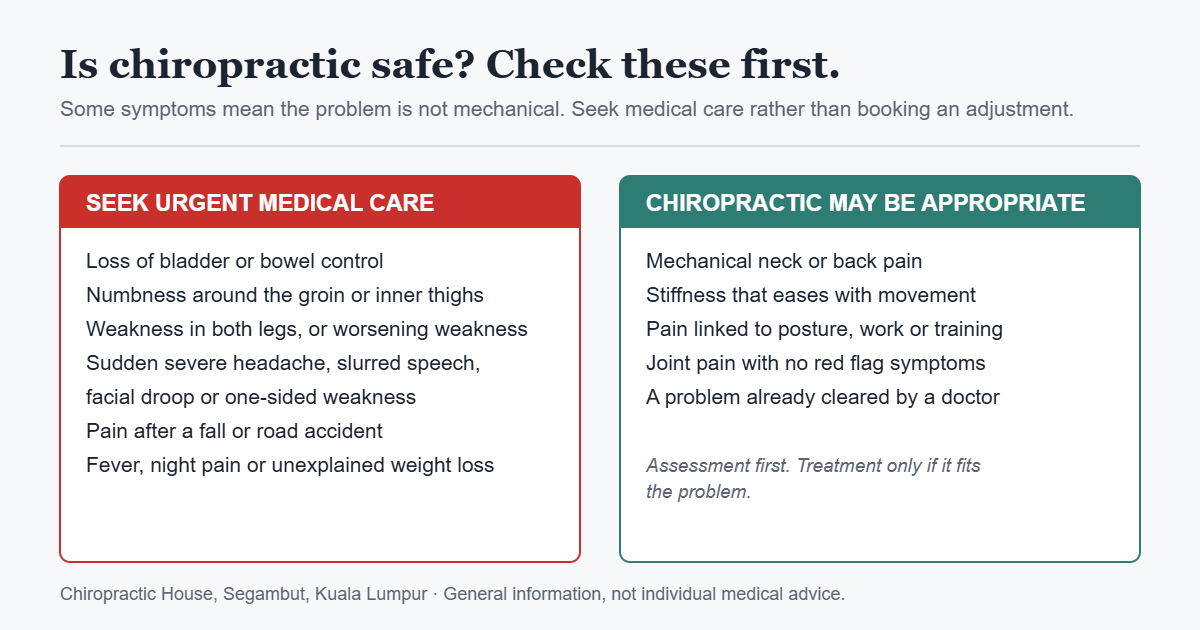
- Loss of bladder or bowel control, difficulty passing urine, or numbness around the groin, buttocks or inner thighs. Combined with back pain, this can indicate cauda equina syndrome, a surgical emergency where delay causes permanent nerve damage.
- Weakness in both legs, or progressive weakness anywhere.
- A sudden, severe headache or neck pain unlike anything you have had before, particularly with visual changes, slurred speech, facial droop, dizziness, difficulty swallowing or weakness on one side. Treat this as a possible stroke and call for emergency help.
- Back or neck pain following significant trauma — a fall, a road accident — especially if you have osteoporosis or are on long-term steroids.
- Unexplained weight loss, night sweats, fever, or pain that is constant and worse at night and not relieved by changing position.
- A history of cancer with new spinal pain.
- Pain in a child or adolescent that is persistent and unexplained.
None of these rule out ever seeing a chiropractor. They mean something needs to be excluded medically first.
Who needs extra caution
Certain conditions change the risk calculation, usually by ruling out high-velocity thrust techniques in the affected area rather than ruling out care altogether:
- Osteoporosis or significantly reduced bone density — bone that fractures more easily
- Inflammatory arthritis, particularly rheumatoid arthritis affecting the upper neck
- Blood-thinning medication or a bleeding disorder
- Known aneurysm, previous artery dissection, or significant vascular disease
- Recent spinal surgery, or metalwork in the spine
- Active infection, or a known or suspected tumour in the spine
- Severe or progressive nerve compression with worsening weakness or numbness
This is why a proper history matters more than the treatment. NCCIH’s guidance is that because pre-existing health problems may increase the risks, practitioners should assess patients thoroughly and patients should disclose their conditions and medications. Tell your practitioner what you take, what you have been diagnosed with, and what surgery you have had — including things you assume are unrelated.
What regulation in Malaysia actually gives you
Chiropractic in Malaysia is regulated under the Traditional and Complementary Medicine Act 2016 (Act 775), gazetted on 10 March 2016 and implemented on 1 August 2016. It is one of seven recognised T&CM practice areas, alongside Traditional Malay Medicine, Traditional Chinese Medicine, Traditional Indian Medicine, Islamic Medical Practice, Homeopathy and Osteopathy. All practitioners in recognised practice areas who wish to practise in Malaysia are required to register with the T&CM Council under the Ministry of Health.
Physiotherapy is a separate profession under separate law — the Allied Health Professions Act 2016 (Act 774), regulated by the Malaysian Allied Health Professions Council. The two are not interchangeable, and neither one is a subset of the other.
Practically, this means you can and should ask whether your practitioner is registered with the T&CM Council, and what their qualification is. The Ministry of Health’s T&CM Division publishes the list of registrable chiropractic qualifications on its portal. If a practitioner is evasive about either question, that tells you something.
When someone else is the better answer
Chiropractic is a reasonable option for mechanical spine and joint pain. It is not a general-purpose treatment, and the evidence for spinal manipulation in non-musculoskeletal conditions is weak — a 2021 review found only six studies of acceptable quality looking at conditions such as high blood pressure or menstrual cramps, and none showed a clear benefit.
Refer yourself onward when:
- Your symptoms are systemic or unexplained — a doctor first, always.
- You need graded rehabilitation and loading over months — a physiotherapist is often better placed for this, and the honest answer is that the two professions overlap considerably.
- You have a confirmed structural problem needing surgical opinion — a spine or orthopaedic specialist.
- Nothing is changing after a reasonable trial. If you have completed the recommended course of treatment and nothing has meaningfully shifted, the plan is wrong. More of the same is not the fix.
For a fuller picture of what an adjustment involves and what it can reasonably be expected to do, see our page on chiropractic adjustment. For an example of how we write about a condition chiropractic care can help manage but does not cure, see costochondritis pain areas. If you would like to talk through whether care is appropriate for your situation before committing to anything, get in touch.
Frequently asked questions
Is it normal to feel sore after an adjustment?
Yes. Local soreness or stiffness for up to a day is the most commonly reported reaction, and it usually settles on its own. Soreness that is severe, spreading, or accompanied by new numbness, weakness or headache is not normal — contact your practitioner or a doctor.
Can chiropractic care cause a stroke?
Neck manipulation has been linked to cervical artery dissection, which can cause a stroke. Whether the manipulation causes the tear or simply coincides with one already forming is still debated in the literature, and no reliable incidence figure exists. The risk is considered low, but it is not zero, and you are entitled to be told about it and to decline neck manipulation.
Is chiropractic safe during pregnancy?
Reports of serious adverse events during pregnancy are very rare, but NCCIH notes there has not been much rigorous research on the question. Discuss it with your obstetrician or doctor as well as your chiropractor, and expect technique and positioning to be modified.
Is chiropractic safe for children?
Children are not small adults, and the evidence base is thinner. Any care should use markedly lower force, be limited to a clear musculoskeletal problem, and involve a doctor where the complaint is not obviously mechanical.
Do I need an X-ray or scan before treatment?
Not routinely. Imaging is indicated when the history or examination raises a specific concern — trauma, red flags, suspected fracture or a condition that changes what is safe to do. Routine imaging of everyone is not supported by guidelines and carries its own downside.
How many sessions should I need?
That depends on the problem, but you should see a measurable change within a handful of visits. Open-ended plans with no defined endpoint are worth questioning. Ask what the goal is and how you will both know when it has been met.
This article is for general information and does not replace individual medical advice. If you have symptoms listed in the red flags section above, seek urgent medical attention. If you are unsure whether chiropractic care is appropriate for your condition, speak with your doctor or a registered practitioner before proceeding.
Eugene Gan
Chiropractor, Bachelor of Science (Hons) Chiropractic
Accredited by the Council on Chiropractic Education Australasia (CCEA)
Chiropractic House, Segambut, Kuala Lumpur
Sources: Spinal Manipulation: What You Need To Know — NCCIH, National Institutes of Health · Notification on Registrable Qualifications for Chiropractic Practitioners under Act 775 — T&CM Division, Ministry of Health Malaysia


