
Usually not. Most Malaysian medical cards classify chiropractic as an alternative or complementary therapy and exclude it outright, alongside acupuncture, osteopathy and bonesetting. A minority of corporate outpatient plans and higher-tier complementary medicine riders do include it. The only way to know is to read your own policy wording or ask HR — and this article tells you exactly which words to look for.
That is the honest answer. Below is the detail, and the three other routes people in Kuala Lumpur try before they end up paying out of pocket.
Why chiropractic falls outside most policies
Chiropractic in Malaysia is regulated under the Traditional and Complementary Medicine Act 2016 (Act 775). It is one of seven recognised practice areas under that Act, alongside Traditional Malay, Chinese and Indian Medicine, Homeopathy, Osteopathy and Islamic Medical Practices. Practitioners register with the T&CM Council under the Ministry of Health.
Physiotherapy is regulated separately, under the Allied Health Professions Act 2016 (Act 774) and the Malaysian Allied Health Professions Council.
That statutory split matters more than most patients realise, because insurers draft policy wording along the same line. “Allied health” and “alternative and complementary medicine” are different clauses in the same document, and they are treated differently. If you want the fuller comparison of what each profession actually does, we set it out in chiropractor vs physiotherapist in Malaysia.
The four ways people in KL actually pay
| Route | Covers chiropractic? | What to check |
|---|---|---|
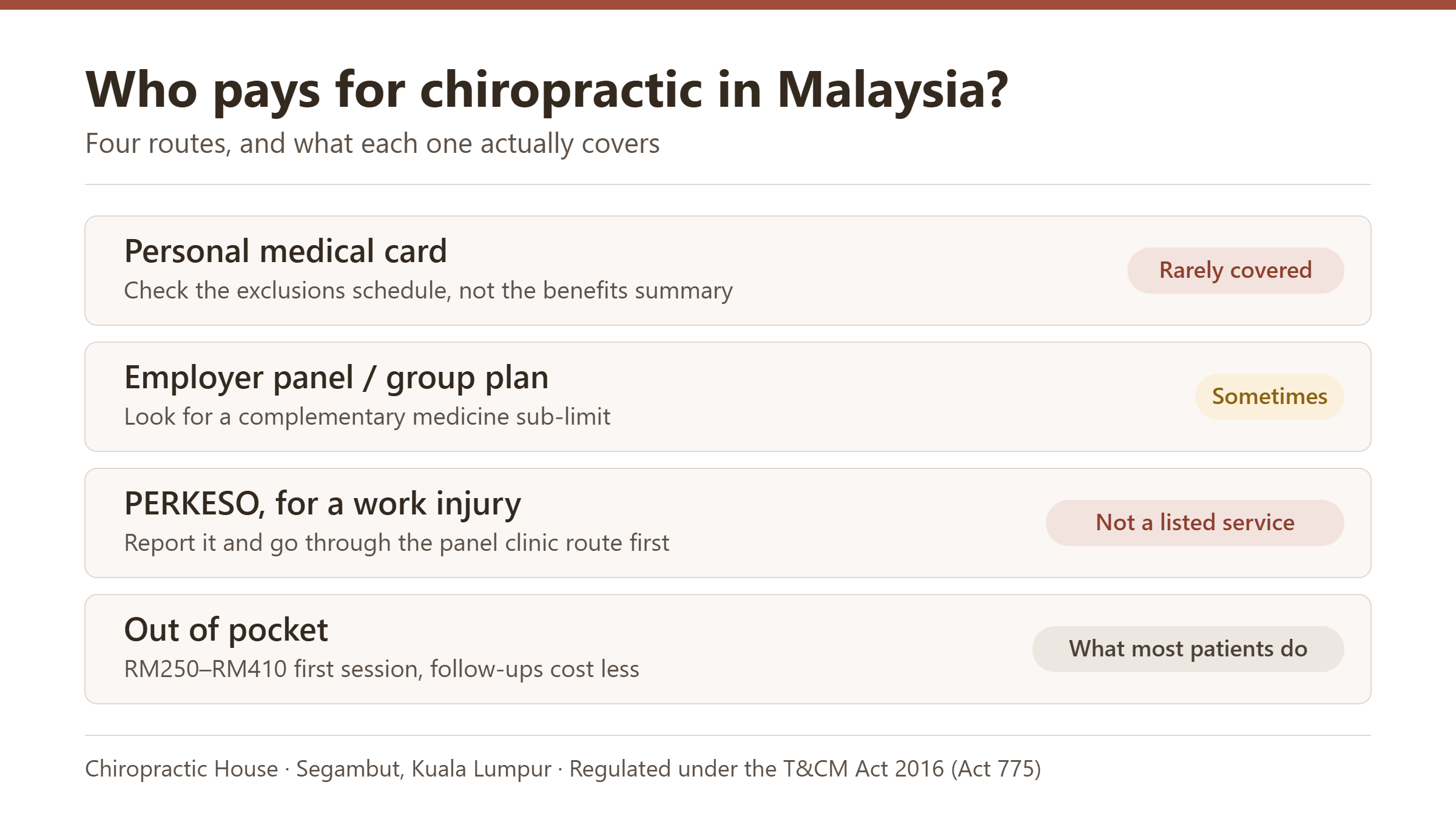
| Personal medical card (individual policy) | Rarely. Usually listed under excluded alternative therapies | The exclusions schedule, not the benefits summary |
| Employer panel / group outpatient plan | Sometimes, in higher-tier or expatriate plans | Whether your plan has a “complementary medicine” sub-limit and whether the clinic is on panel |
| PERKESO (SOCSO), for a work injury | Not a listed rehabilitation service | Report the injury and go through the PERKESO panel clinic route first |
| Out of pocket | N/A — this is what most patients do | Fee per session, and how many sessions before review |
What an exclusion clause actually looks like
Policy language is more explicit than people expect. A group medical schedule used for international students in Malaysia lists among its exclusions: “Alternative therapies such as (but not limited to) Acupuncture, Acupressure, Chiropractic, Osteopathy, Reflexology, Bonesetting, Massage, Aroma Therapy, Herbal, Podiatric, Dietetic consultation and treatment… & Traditional Complimentary Medicine.”
The same schedule restricts physiotherapy too: outpatient physiotherapy is not payable on a GP referral, and only becomes claimable when a specialist refers it and the member has first been admitted as an inpatient for that condition.
That second clause is worth reading twice. Even the professions that are covered are often covered only after hospitalisation. If you are walking into a clinic with three weeks of low back pain and no admission, an outpatient claim is unlikely either way.
If it happened at work
If your back or shoulder problem arose out of your employment, the first call is PERKESO, not your chiropractor. Report it, get seen at a PERKESO panel clinic, and let the claim open properly. PERKESO’s published rehabilitation services cover prosthetics, orthotics, medical aids and implants, supported by a treating doctor’s recommendation. Chiropractic is not on that list. Trying to claim it retrospectively rarely works, and starting private treatment first can complicate the documentation.
One thing that does work in your favour
Since 1 March 2024, the Ministry of Finance has exempted T&CM practitioners registered under Act 775 from the service tax on their services — chiropractic named specifically among them. In practice that means the fee you are quoted is the fee you pay, with no service tax added on top. It is a small point, but it is one of the few places where the Malaysian regulatory framework works in the patient’s favour rather than against.
Do not confuse this with tax relief. LHDN’s personal medical relief categories are narrowly defined — serious diseases, fertility treatment, certain examinations and mental health consultations by registered psychiatrists or clinical psychologists. Routine chiropractic care for back pain does not sit in those categories. If you think your circumstances are unusual, ask a tax agent rather than assuming.
Five questions to ask before your first appointment
Ask your insurer or HR these, in writing, and keep the reply:
- Does the policy exclude alternative or complementary therapy as a category?
- If there is a complementary medicine benefit, what is the annual sub-limit in ringgit?
- Does a claim require a doctor’s referral, and does it need to be a specialist rather than a GP?
- Is reimbursement limited to panel providers, and is there a panel list?
- Does outpatient treatment require prior inpatient admission for the same condition?
Question five catches most people out.
Red flags — stop reading about insurance and get seen today
Some symptoms are not a claims question. Go to the emergency department at a hospital such as Hospital Kuala Lumpur, Hospital Sungai Buloh, or a private hospital near you — do not wait for a chiropractic appointment — if you have:
- Loss of bladder or bowel control, or numbness around the groin, buttocks or inner thighs
- Weakness in one or both legs that is getting worse, or a foot you cannot lift
- Back pain following a significant fall, road accident or direct blow
- Back pain with fever, unexplained weight loss, night sweats, or a history of cancer
- Sudden severe pain in an older adult with known or suspected osteoporosis
- Chest pain, breathlessness, sweating or pain radiating to the jaw or arm — that is a cardiac emergency, not a musculoskeletal one
These point to conditions that need medical imaging and a doctor, not manual therapy.
What it costs at Chiropractic House in Segambut
A first session, which includes assessment and treatment, is RM250–RM410. Follow-up sessions cost less. We are in Suria @ North Kiara, off Jalan Kuching, within a short drive of Segambut, Mont Kiara, Dutamas and Sri Hartamas.
We are a cash-pay clinic. We do not bill insurers directly, and we do not tell patients their card will cover it — because for most Malaysian policies it will not. What we can do is issue a proper receipt and clinical documentation, which is what you need if you intend to submit a claim under a plan that does include complementary medicine.
Chiropractic care does not cure structural spinal conditions, and no honest practitioner should promise that it will. For mechanical back and neck pain it is one reasonable option among several — alongside physiotherapy, exercise rehabilitation, and in some cases medical management. If your presentation is better served by a physiotherapist or a doctor, we will say so.
You can read more about what an adjustment involves in chiropractic adjustment explained, or contact us if you want to ask about fees before booking.
Frequently asked questions
Will my company’s panel clinic cover a chiropractor?
Panel arrangements are usually built around GP clinics and, in larger plans, specialists. Chiropractic is rarely on a standard Malaysian panel. Higher-tier corporate and expatriate plans sometimes include a complementary medicine allowance. Ask HR for the benefits schedule, not the one-page summary.
Can I claim chiropractic through PERKESO if I hurt my back at work?
Report the injury to PERKESO and attend a panel clinic. Chiropractic is not among PERKESO’s listed rehabilitation services, so treat private chiropractic care as separate and self-funded.
Is there GST or SST on my chiropractic bill?
Registered T&CM practitioners under Act 775 were exempted from the service tax on these services with effect from 1 March 2024. Your quoted fee should be the total.
My insurer covers physiotherapy but not chiropractic. Should I just see a physiotherapist?
If cost is the deciding factor, that is a perfectly sensible choice — and for many conditions physiotherapy is the more appropriate starting point anyway. Note that even physiotherapy is often restricted to specialist referrals and post-hospitalisation cases in Malaysian policies, so check before you assume.
Do I need a doctor’s referral to see a chiropractor in Malaysia?
No. You can book directly. But if you intend to claim against any policy, a referral is frequently a condition of payment, so get one first if a claim matters to you.
How many sessions will I need?
It depends on the condition and how long you have had it. Anyone quoting you a fixed package before assessing you is selling, not treating. We review progress as we go, and if you are not improving, we say so and refer on.
This article is general information and not medical advice. It does not describe or predict your individual case. If you have back, neck or joint pain, see a qualified healthcare professional for assessment. Insurance and tax information is provided for general guidance only — verify coverage with your own insurer, employer or tax agent, as policies and rules change.
Eugene Gan
Chiropractor, Bachelor of Science (Hons) Chiropractic
Accredited by the Council on Chiropractic Education Australasia (CCEA)
Chiropractic House, Segambut, Kuala Lumpur


