
If your shoulder has slowly become both painful and stiff over several months, and you now cannot reach behind your back or lift your arm sideways even when someone else tries to move it for you, that pattern is typical of frozen shoulder. It is a real condition of the joint capsule, not weak muscles or bad posture. Most cases settle eventually, but it is slow — often one to three years — and the right treatment depends heavily on which stage you are in.
I see this often at the clinic in Segambut, usually in patients in their fifties who have been told to “just rest it” for six months and have got worse instead. This article explains what is actually happening, what the evidence supports, what it does not, and when you should be seeing a doctor rather than a chiropractor.
What frozen shoulder actually is
The medical name is adhesive capsulitis. The capsule surrounding the shoulder joint becomes inflamed and then fibrotic — it thickens and physically contracts, shrinking the space the joint has to move in.
That distinction matters. In most shoulder problems, pain limits movement. In frozen shoulder, the tissue itself has shortened, so the range is gone whether or not you are trying. If a practitioner moves your arm for you while you stay completely relaxed, it still stops in the same place. That single finding — restricted passive movement, especially rotating the arm outwards — is the clinical hallmark. Diagnosis is made on examination, not on a scan. Imaging is used mainly to rule out other causes.
It affects roughly 2% to 5% of the general population, most commonly around age 55, slightly more often in women, and more often in the non-dominant arm.
Why Malaysians should pay attention to this one
Diabetes is the strongest known risk factor. Reported prevalence of adhesive capsulitis is around 11–30% in people with diabetes, against 2–10% in those without.
That is not an abstract concern here. The Ministry of Health’s National Health and Morbidity Survey 2023 found diabetes in 15.6% of Malaysian adults — 9.7% already diagnosed, and a further 5.9% with raised blood glucose who did not know it. Thyroid disorders, previous shoulder injury, shoulder or chest surgery, and any period of prolonged immobilisation also raise the risk.
If you develop frozen shoulder and have never had your blood sugar checked, get it checked. Longer duration of diabetes is associated with a more stubborn shoulder and poorer treatment outcomes, so the shoulder is sometimes the first thing that brings an undiagnosed metabolic problem to attention.
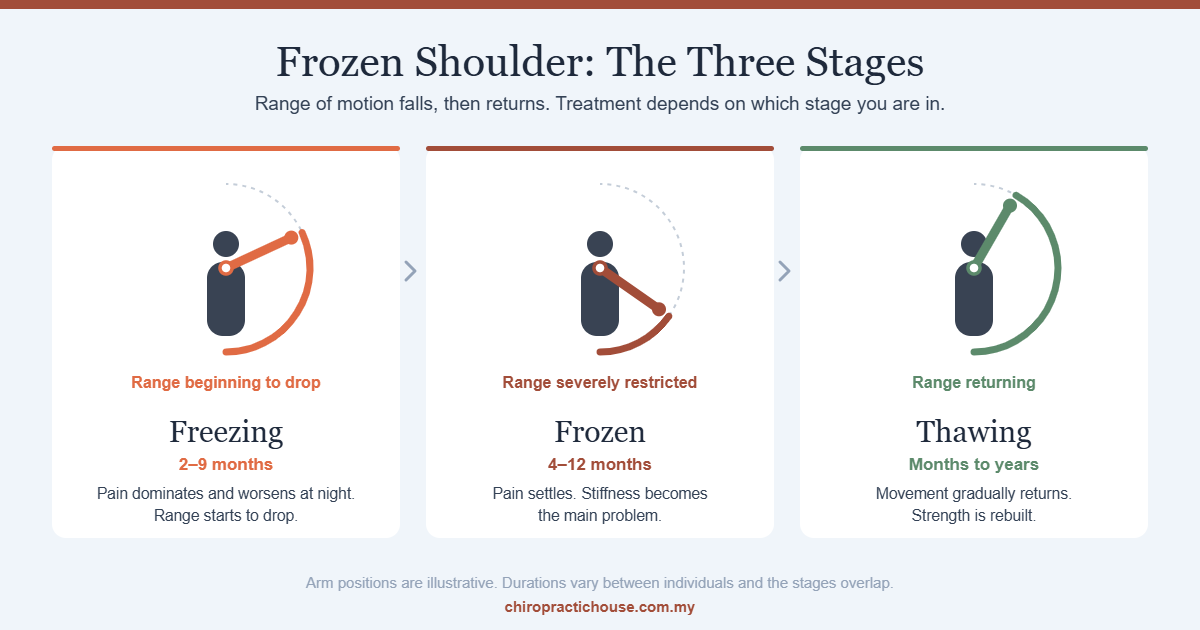
The three stages, and why the stage changes the treatment
| Stage | Typical duration | What dominates | What treatment aims to do |
|---|---|---|---|
| Freezing | 2–9 months | Diffuse pain, worse at night, range starting to drop | Control pain and protect sleep. Aggressive stretching here usually makes things worse. |
| Frozen | 4–12 months | Pain settles; stiffness becomes the main problem | Restore range. This is where mobilisation and structured exercise earn their place. |
| Thawing | Months to years | Gradual return of movement | Rebuild strength and confidence; correct the compensations built up over a year of guarding. |
The stages overlap and the timings vary a great deal between people. The practical point is simple: treatment that helps in the frozen stage can genuinely aggravate the freezing stage. If someone offers to stretch a hot, exquisitely painful, early-stage shoulder into range, that is the wrong treatment at the wrong time.
Red flags — see a doctor, not a chiropractor
Most stiff, painful shoulders are not sinister. Some are. Book an urgent medical appointment, or go to A&E, if any of the following apply:
- Fever, chills, night sweats, or a shoulder that is hot, red and swollen. This can indicate septic arthritis — a joint infection that needs same-day assessment.
- Unexplained weight loss, or a history of cancer. Persistent shoulder pain in someone with a cancer history requires investigation to exclude bone involvement.
- A visible lump or mass around the shoulder or armpit.
- New weakness or numbness in the arm or hand, or symptoms in both arms — this points to a nerve or spinal cause rather than the joint capsule.
- Significant trauma — a fall, a road accident, a dislocation — especially if you cannot use the arm at all. Fracture must be excluded first.
- Chest pressure, breathlessness, sweating, or pain spreading into the jaw or left arm. Cardiac pain can present as shoulder or arm pain. Treat this as an emergency.
None of these are chiropractic problems. If you have any of them, please see a doctor first. I would rather turn a patient away at the front desk than treat a shoulder that needed a blood test.
What the evidence actually supports
I want to be direct here, because there is a lot of confident marketing around this condition.
Nothing reliably makes frozen shoulder go away quickly. It is largely self-limiting, and around 80% of patients regain near-normal function with appropriate management — but “appropriate management” mostly means time, sensible loading, pain control, and not making it worse. Roughly 10–20% are left with some lasting stiffness or discomfort.
Corticosteroid injection gives the most reliable short-term relief of pain and stiffness, but Cochrane reviews have found the benefit is generally not maintained beyond about six weeks. It buys a useful window rather than fixing the problem — which is precisely why it is often combined with rehabilitation rather than used alone.
Manual therapy and exercise are the mainstay of conservative care and are what physiotherapy guidelines are built around. But the research is weaker than most clinics admit. A 2023 systematic review with meta-analysis in the Journal of Manual & Manipulative Therapy concluded that inconsistency across study designs, techniques and dosing made it impossible to give strong recommendations on the optimal amount or type of manual therapy. Reviews of ultrasound and electrical modalities have been similarly unconvincing.
Chiropractic care does not cure frozen shoulder. No form of manual therapy dissolves capsular fibrosis. What good conservative care can realistically do is reduce pain, maintain and gradually recover range, keep the surrounding shoulder blade and neck mechanics working, and stop you spending a year compensating in ways that create a second problem.
If your shoulder is not improving after several months of conservative care, the next conversation is with an orthopaedic specialist — hydrodilatation, manipulation under anaesthesia, or arthroscopic capsular release are all reasonable options at that point, and I will say so.
How chiropractic care fits in
Chiropractic in Malaysia is regulated under the Traditional and Complementary Medicine Act 2016 (Act 775), with the T&CM Council under the Ministry of Health. Physiotherapy sits separately, under the Allied Health Professions Act 2016 (Act 774). Both professions treat this condition, and there is no rivalry worth your time — what matters is that whoever sees you understands stage-appropriate loading.
In practice, care for a frozen shoulder at our clinic in Segambut involves assessing passive range in each direction to confirm the pattern and rule out rotator cuff and cervical causes, treating the neck and shoulder blade — which are almost always stiff and overworked by the time you arrive — using soft tissue work and, where appropriate, chiropractic adjustment to the thoracic spine and scapular region rather than forcing the shoulder joint itself, and giving you a home programme you can actually do daily. Adjunct modalities such as shockwave therapy are used selectively for surrounding tendon and soft tissue pain, not as a treatment for capsular contracture.
The home programme matters more than anything done in the clinic. A stiff capsule responds to frequent, gentle, tolerable movement, not to one heroic session a week.
Frequently asked questions
How long does frozen shoulder last?
Commonly one to three years from first symptom to full recovery, though some people resolve within months. The freezing stage alone typically runs 2 to 9 months.
Will it happen to the other shoulder?
It can. It usually does not happen at the same time, and having had it once on one side does not mean it will recur on that same side.
Should I push through the pain when stretching?
No. Working into mild discomfort that settles quickly is fine. Sharp pain, or pain that lingers for hours afterwards, means you have gone too far — and in the early inflammatory stage, forcing range tends to prolong things.
Is it the same as a rotator cuff tear?
No. With a cuff tear you usually cannot lift the arm yourself, but someone else can move it for you through a much fuller range. In frozen shoulder, passive movement is restricted too. That is the distinguishing test.
Can chiropractic treatment cure it?
No. It can help manage pain, maintain range and address the compensations that build up around the shoulder, but the capsule follows its own timeline. Anyone promising a cure or a fixed number of sessions to resolve it is overstating what is possible.
Do I need an MRI?
Usually not. Frozen shoulder is diagnosed clinically. Imaging is ordered to exclude other causes when the presentation is atypical, when there has been trauma, or when surgery is being considered.
Where to start
If your shoulder is stiff and you are unsure what you are dealing with, a proper examination is the first step — it takes a few minutes to distinguish a frozen shoulder from a cuff problem or a neck-referred pain, and the answer changes what you should be doing at home. You can contact us to arrange an assessment.
This article is for general information and does not constitute medical advice, diagnosis or treatment. Shoulder pain has many causes and can occasionally signal a serious medical condition. Please consult a qualified healthcare professional about your own symptoms. If you have any of the red flag symptoms listed above, seek urgent medical attention.
Eugene Gan
Chiropractor, Bachelor of Science (Hons) Chiropractic
Accredited by the Council on Chiropractic Education Australasia (CCEA)
Chiropractic House, Segambut, Kuala Lumpur


