
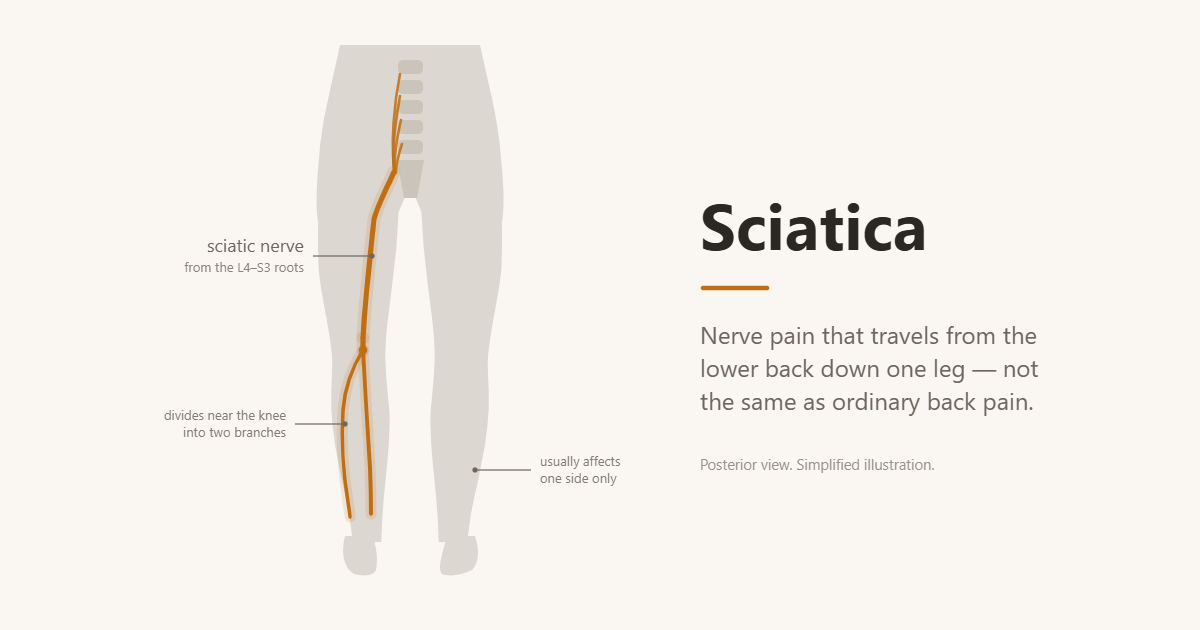
Sciatica is pain that travels from the lower back or buttock down the back of one leg, caused by irritation or compression of the sciatic nerve or one of the nerve roots that form it. Most cases settle on their own within four to six weeks. A small number are a medical emergency. The job of this article is to help you tell the difference, and to be honest about what a chiropractor can and cannot do for it.
What sciatica actually is
The sciatic nerve is formed from the L4 to S3 nerve roots, which join in the pelvis and travel down the back of the thigh before splitting at the knee. It is the largest nerve in the body, up to 2 cm across (StatPearls, NIH).
Sciatica is a symptom, not a diagnosis. The word only means that something along that nerve pathway is being irritated or compressed. The most common cause is a herniated or bulging lumbar disc. In older patients, lumbar spinal stenosis — narrowing of the spinal canal — is frequent. Spondylolisthesis, where one vertebra slips forward relative to the one below, can do it too. So can muscular spasm around the pelvis, and, rarely, a spinal mass, infection or bleed.
A common misunderstanding: not all leg pain is sciatica, and not all back pain is sciatica. If your pain sits in the lower back and does not travel below the buttock, it is probably not sciatic nerve pain. That matters, because the treatment is different.
Some numbers, since patients always ask. Lifetime incidence is between 10% and 40%, with an annual incidence of 1% to 5%. Peak incidence is in the fourth decade, and it rarely appears before age 20 unless there has been trauma. There is an occupational pattern — machine operators, long-distance drivers, and jobs involving awkward sustained positions are over-represented (StatPearls, NIH).
Red flags — go to a hospital, not a chiropractor
Read this section before anything else. If any of the following applies to you, do not book a chiropractic appointment. Go to an emergency department.
- Difficulty passing urine, loss of bladder control, or not being able to feel when your bladder is full.
- Loss of bowel control, or numbness when wiping.
- Numbness or altered sensation around the genitals, perineum, or inner thighs — the “saddle” area. NICE added genital sensory loss to its red-flag list specifically because the earlier wording was catching patients too late (NICE CKS update, reported by MPS).
- Weakness in both legs, or weakness that is getting worse — particularly trouble straightening the knee, lifting the foot, or turning the ankle outwards.
- A foot that has started to drag or slap when you walk (foot drop).
These can indicate cauda equina syndrome, where the bundle of nerves at the base of the spinal cord is being compressed. It needs an urgent MRI and, if confirmed, urgent surgery. Delay causes permanent damage.
Separately, see a doctor rather than a chiropractor if your leg pain comes with fever, night sweats, unexplained weight loss, a history of cancer, recent significant trauma, or if you are immunocompromised or on anticoagulants. These raise the possibility of infection, fracture, tumour or a spinal bleed — none managed with manual therapy (StatPearls, NIH).
I would rather turn away someone who did not need turning away than treat someone who needed a scan.
What usually happens without treatment
Most sciatica gets better. StatPearls puts it plainly: most cases resolve in less than four to six weeks with no long-term complications, even if no medical care is sought. Where there is a genuine neurological deficit, recovery takes longer but is still generally good.
That has two implications. First, if you are two weeks in and improving, patience and sensible activity may be all you need. Second — the awkward one for my profession — any treatment given during those first weeks will look effective, because the condition was going to improve anyway. Be sceptical of anyone, including a chiropractor, who claims credit for a recovery that was always going to happen.
The factors that predict a worse course are not mainly structural. Poor occupational ergonomics, depression, and difficult socioeconomic circumstances are associated with chronic and recurrent sciatica.
Treatment options, compared honestly
| Option | What it is | Evidence position | Best suited to |
|---|---|---|---|
| Time and staying active | Avoiding bed rest, walking, gentle movement | Strongly supported; most cases resolve in 4–6 weeks | Almost everyone in the first few weeks |
| Exercise and rehabilitation | Graded loading, core and hip work, nerve mobility | Recommended by NICE as a central component | Most people, especially recurrent cases |
| Manual therapy (chiropractic, mobilisation, soft tissue) | Spinal manipulation and hands-on techniques | NICE recommends it only as part of a package including exercise, not on its own. A 2025 network meta-analysis rated the evidence very low confidence — see below | Mechanical, non-progressive cases without red flags |
| NSAIDs and other medication | Short course of anti-inflammatories, occasionally neuropathic agents | Standard first-line medical management | Pain limiting sleep or basic function — discuss with a doctor or pharmacist |
| Epidural steroid injection | Corticosteroid injected near the affected nerve root | Used where conservative care has failed; effect tends to be short to medium term | Persistent radicular pain under specialist care |
| Surgery | Discectomy or decompression | Reserved for neurological deficit or failed conservative care | A minority of cases |
Two things worth drawing out of that table.
Chiropractic care does not cure a disc herniation. Manual therapy does not push a disc back into place — that is not a mechanism that holds up. What it can reasonably do is reduce pain, improve movement in stiff segments, and make it possible to do the exercise that actually drives recovery. If a clinic tells you they will “put the disc back”, ask them to explain how.
Manual therapy on its own is not the recommendation. NICE is explicit that spinal manipulation, mobilisation and soft tissue work should be considered for low back pain with or without sciatica only as part of a treatment package including exercise (NICE NG59). If you have had twenty sessions and been given no exercises, something has gone wrong. NICE also recommends against traction.
How strong is the evidence for chiropractic in sciatica, really?
Weaker than my profession usually admits, and you deserve the actual answer.
The most recent systematic review pooled 50 randomised trials covering 4,920 patients with chronic sciatica. Spinal manipulative therapy did show one of the largest short-term reductions in leg pain compared with placebo. But the same authors rated that finding very low confidence, and their overall conclusion was blunt: no high-quality evidence confirms that any non-surgical intervention is superior for chronic sciatica (Zhu et al., The Journal of Pain, 2025 — indexed on PubMed, DOI).
So: manual therapy is a reasonable thing to try for the right presentation, and it may help your pain in the short term. It is not a proven superior treatment, and anyone who tells you otherwise is going beyond the evidence.
How sciatica is assessed
Sciatica is a clinical diagnosis. A careful history and a neurological examination — reflexes, muscle strength, sensation, straight leg raise — do most of the work. Imaging is of little value early on. MRI becomes appropriate if pain has persisted for six to eight weeks without response to conservative care, or immediately if there is a neurological deficit or suspected mass effect (StatPearls, NIH).
Worth knowing in Malaysia, where patients often arrive having already paid for an MRI: scans frequently show disc bulges in people with no symptoms at all. The scan needs to be interpreted alongside the examination, not instead of it.
At Chiropractic House we assess before we treat, and where the picture does not fit a mechanical problem, we refer. Approaches such as chiropractic adjustment and dry needling are used selectively, alongside a rehabilitation plan.
A note on regulation in Malaysia
Chiropractic is regulated under the Traditional and Complementary Medicine Act 2016 (Act 775), administered by the T&CM Council under the Ministry of Health. It is one of seven recognised T&CM practice areas, recognised as such on 1 August 2017, with practitioner registration enforced from 1 March 2021 (T&CM Division, MOH).
Physiotherapy is a separate profession under separate law — the Allied Health Professions Act 2016 (Act 774), under the Malaysian Allied Health Professions Council. Neither is a subset of the other. For sciatica, both can be reasonable options. Ask any practitioner you see whether they are registered; you are entitled to ask.
Frequently asked questions
Should I rest or keep moving?
Keep moving, within reason. Prolonged bed rest is not recommended. Avoid the movements that sharply provoke the leg pain — for most people that is loaded bending and lifting — but walking and gentle activity help.
How long before I should be worried?
If you are not improving at all after six to eight weeks of sensible conservative care, imaging and a medical review become appropriate. But if any red flag appears at any stage — bladder or bowel changes, saddle numbness, worsening weakness — that is same-day, not six weeks.
Is the popping sound during an adjustment the disc moving?
No. The sound is generally attributed to a gas cavitation event within the joint. It is not a disc relocating, and whether or not there is a sound tells you nothing about whether the treatment worked.
Can I have chiropractic treatment if I have a confirmed disc herniation?
Sometimes. It depends on the examination, specifically whether there is a progressive neurological deficit. A herniation on MRI with stable symptoms is a different situation from one with worsening weakness — a decision to make after an assessment, not from a scan report alone.
Is my sciatica caused by sitting at a desk all day?
Sustained sitting is a plausible aggravating factor, and occupational posture is associated with sciatica risk, but it is rarely the whole story. If you work at a desk, our guide to fixing office posture is worth reading alongside this.
What if it is not sciatica at all?
Piriformis syndrome, hip joint pathology and referred pain from the sacroiliac joint can all mimic sciatica. So can peripheral neuropathy from diabetes. Distinguishing them is the point of the examination.
Medical disclaimer. This article is for general information and does not constitute medical advice, diagnosis or treatment. It cannot account for your individual circumstances. If you have any of the red-flag symptoms described above, seek urgent medical attention. For anything else, please consult a registered healthcare practitioner. You are welcome to get in touch with the clinic if you would like an assessment.
Eugene Gan
Chiropractor, Bachelor of Science (Hons) Chiropractic
Accredited by the Council on Chiropractic Education Australasia (CCEA)
Chiropractic House, Segambut, Kuala Lumpur


