
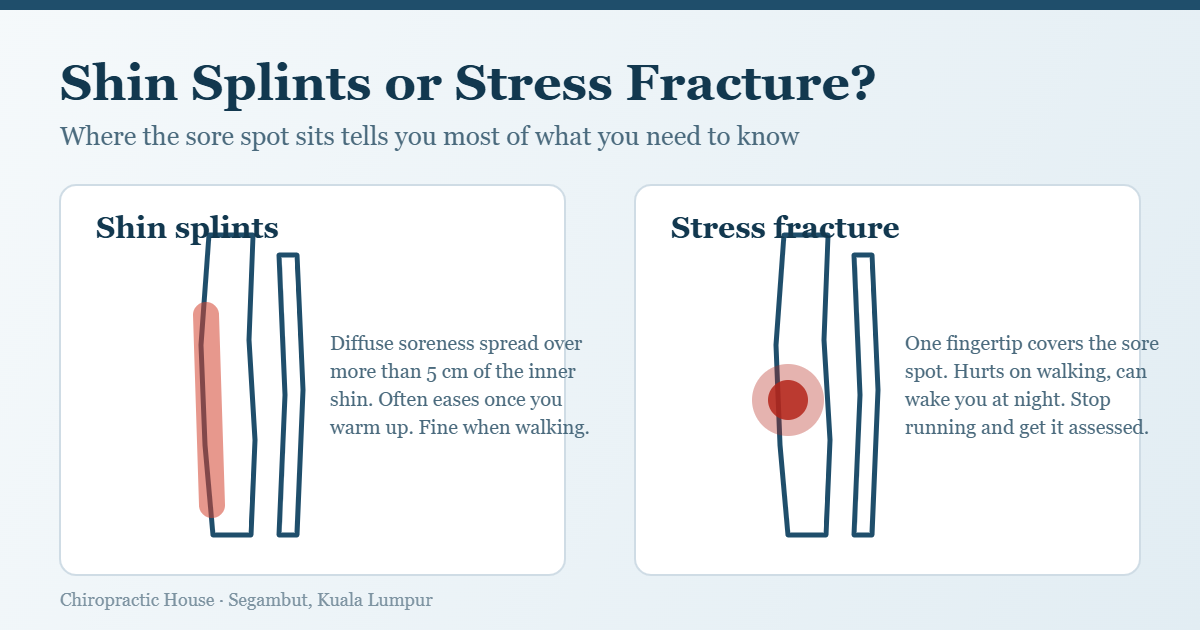
Short answer: if the sore spot along your shin is spread over a hand’s width and eases once you warm up, it is most likely shin splints. If you can cover the painful spot with one fingertip, it hurts when you walk, and it wakes you at night, treat it as a possible stress fracture and stop running until someone has looked at it. The two sit on the same continuum of bone stress injury, and the difference between them is roughly three weeks of sensible training versus three months off.
With the Kuala Lumpur Standard Chartered Marathon on 3 and 4 October, this is peak season for shin pain in KL. The final weeks of a training block are exactly when mileage peaks and when people push through something they should be backing off from.
What shin splints actually are
The clinical name is medial tibial stress syndrome, and it describes exercise-induced pain along the inner border of the shin bone, in the lower two-thirds. It is one of the most common overuse injuries in running: reported incidence runs from about 13.6% to 20% in runners, rising to 35% to 56% in military recruits, according to the NIH StatPearls review of medial tibial stress syndrome. It typically follows a sudden change in training — more frequency, more distance, or more intensity — rather than any single moment of injury.
A tibial stress fracture is the same process further along. Repetitive loading produces microdamage faster than the bone can repair it; the periosteum is irritated first, and if the loading continues the cortex itself can crack. Not everyone with shin splints goes on to fracture — but those who do are almost always the ones who kept running on it.
How to tell them apart
The single most useful thing you can do is run one finger slowly along the inner edge of your shin bone and map where it hurts.
| Sign | Shin splints (MTSS) | Tibial stress fracture |
|---|---|---|
| Size of the sore area | Diffuse, usually more than 5 cm along the inner shin | Focal — under 5 cm, often coverable with a fingertip |
| Pain during a run | Sore at the start, often eases as you warm up | Builds through the run and keeps getting worse |
| Pain when walking | Usually fine | Often painful on ordinary walking |
| Pain at rest or at night | Uncommon | Common, and a significant warning sign |
| Hopping on that leg | Uncomfortable | Sharply painful, often impossible |
| Where on the bone | Inner (posteromedial) border | Can be the front (anterior) cortex — the higher-risk site |
| Recovery timeframe | Weeks, with load reduction | Typically 8 to 12 weeks for higher-grade injuries |
Two things worth knowing. Plain X-rays are normal in shin splints and frequently normal in an early stress fracture too, so a clear X-ray does not rule one out; MRI is the imaging that settles it, because it grades the injury from periosteal swelling through to a cortical crack. And burning, cramping, numbness or pins and needles in the foot point away from both diagnoses, suggesting compartment syndrome or a nerve problem instead.
Why KL runners are set up for this
Some of it is the training calendar. A marathon block peaking in September, run almost entirely on concrete and tarmac around Desa ParkCity, Bukit Kiara, the Lake Gardens or Taman Tasik Titiwangsa, loads the tibia the same way every session. Trail and grass vary the stimulus; unbroken hard surfaces do not.
Some of it is the climate. Heat and humidity push most serious training into the 6am window or after 8pm, which compresses sessions and tempts runners into shorter, faster efforts instead of easy volume. Heat also makes pace a poor guide to effort — a run intended as an easy jog can be a much harder session than planned.
And then there is a distinctly Malaysian factor that surprises people. Bone stress injuries are associated with low vitamin D, and in a cross-sectional study of multi-ethnic adults in Kuala Lumpur, 67.4% had vitamin D deficiency, with the proportion varying substantially by ethnic group. Living on the equator is no protection when the working day is spent indoors and midday sun is actively avoided. Studies in military recruits have linked vitamin D deficiency to increased stress injury risk, and optimising vitamin D and calcium has been shown to reduce stress fracture incidence in that population. If your shin pain keeps coming back, it is a reasonable thing to ask your doctor to check.
Red flags: stop running and get it looked at
- Pinpoint tenderness you can cover with one fingertip, particularly on the front of the shin
- Pain that is present when you walk, or that wakes you at night
- Pain that has worsened over consecutive weeks despite reducing your mileage
- You cannot hop on that leg
- Visible swelling, redness and warmth over the shin, especially with fever
- Calf pain with swelling and warmth, particularly after a long flight or period of immobility
- Numbness, pins and needles, or weakness in the foot
An anterior tibial stress fracture is the one to take seriously. It is classed as a high-risk fracture because it heals poorly and can progress to a complete break. For a non-urgent assessment, your Klinik Kesihatan is the standard route into government orthopaedic or sports medicine care and any imaging that follows. For fever with a hot, swollen limb, or a calf that is swollen and warm, go to an emergency department the same day.
What actually helps — and what does not
This is the part where honesty is more useful than optimism. For shin splints, the treatment that does the heavy lifting is load management: reducing the aggravating activity, keeping fitness through low-impact work, and rebuilding gradually. Nothing else substitutes for that, and no clinic can shortcut it.
On the adjuncts, the evidence is mixed and worth stating plainly. The StatPearls review reports that low-energy laser therapy, stretching, strengthening exercises, leg braces and compression stockings have not shown benefit for this specific condition. Extracorporeal shockwave therapy has shown more promise: a prospective controlled study found that adding it to a return-to-running programme reduced recovery time compared with the programme alone — though the reviewers are clear that further investigation is needed. Arch-support foot orthoses have been shown to speed recovery compared with sham inserts.
So if you come to us with shin pain, the useful conversation is about training load, calf and hip strength, footwear and foot mechanics — not a series of adjustments. We do offer shockwave therapy and sports massage, and shockwave has a reasonable evidence base here, but they are adjuncts to a loading plan, not replacements for one. For a suspected stress fracture there is no manual treatment at all: it needs imaging and protected healing. If your rehabilitation is mostly graded exercise prescription, a physiotherapist may be the better fit, and the difference between the two professions in Malaysia is a genuine legal one — chiropractic sits under the Traditional and Complementary Medicine Act 2016 (Act 775), physiotherapy under the Allied Health Professions Act 2016 (Act 774).
An assessment at Chiropractic House is RM250 to RM410 for a first session, and follow-ups cost less. We are at Suria @ North Kiara, off Jalan Kuching, which is a short drive from Segambut, Mont Kiara, Sri Hartamas and Dutamas. We are a cash-pay clinic and do not bill insurers directly, though we issue receipts and clinical documentation if you want to claim yourself.
Getting back to running
Published protocols vary, but the principles are consistent. Do not restart until bony tenderness has been gone for a week and you have had two consecutive pain-free days in normal daily activity, and you can walk pain-free for 30 minutes. Then begin with run-walk intervals — 30 seconds of running at 30% to 50% of your usual pace, alternated with walking — three days a week with a rest day between, building duration over about four weeks. After that, increase distance by no more than 10% a week until you are back at your pre-injury level, and only then reintroduce speed. Start on flat surfaces. If pain returns at rest, drop back a stage.
Frequently asked questions
Can I still run the KL Marathon with shin splints?
That depends on which problem you have, which is why the fingertip test matters. Shin splints that settle within a run and are painless on walking may be manageable with a reduced build-up. Focal pain that hurts when you walk should not be run on at all, and a marathon is the worst possible way to test the theory.
Will new running shoes fix it?
Rarely on their own, though worn-out shoes are worth replacing. Arch-support orthoses have evidence for speeding recovery, and prefabricated orthotics reduced shin splint incidence in one naval recruit trial. Footwear is a contributing factor, not usually the main one — the main one is almost always how quickly your training load increased.
Should I stretch my calves more?
Stretching has not been shown to help this particular condition. That does not make it harmful, but it is not the treatment. Restricted ankle dorsiflexion is a recognised risk factor, so mobility work has a place in prevention — just do not expect it to resolve an active flare.
Do I need an MRI?
Not for straightforward shin splints, which is a clinical diagnosis made from history and examination. MRI is warranted when a stress fracture is suspected, when symptoms persist despite proper load reduction, or when the diagnosis is uncertain. A normal X-ray is not reassurance.
Can I keep training while it settles?
For shin splints, usually yes — swimming, cycling and deep-water running maintain fitness without loading the tibia. For a confirmed stress fracture, what you can do depends on the grade and location, and that decision belongs to the doctor managing it.
Is this the same as the pain I get playing badminton?
Court sports load the lower limb differently, with more jumping and lunging and more ankle and knee involvement — we cover that pattern in our article on badminton injuries in Malaysia. Shin pain from repeated jumping can still be a bone stress injury, and the same fingertip test applies.
If shin pain has lasted more than two or three weeks, or you have been quietly running around it, have it assessed before the mileage climbs any further. You can get in touch with the clinic here. If any of the red flags above apply, see a doctor first.
Medical disclaimer: this article is general information, not a diagnosis or a treatment plan. Shin pain has several possible causes and some of them need medical rather than manual care. Please see a qualified healthcare professional about your own symptoms, and seek urgent medical attention if any of the red flags described above apply to you.
Written by Eugene Gan, Chiropractor, Bachelor of Science (Hons) Chiropractic, accredited by the Council on Chiropractic Education Australasia (CCEA). Chiropractic House, Suria @ North Kiara, off Jalan Kuching, Kuala Lumpur.


