

Chronic back pain has become one of the most common — and most mismanaged — conditions affecting people across Kuala Lumpur. Shockwave therapy for back pain is changing that equation. The Swiss Dolorclast system delivers precisely calibrated acoustic energy deep into damaged tissue, triggering genuine biological repair rather than simply suppressing symptoms. At Chiropractic House in Kepong, KL, this technology is integrated into a broader treatment framework that combines cellular-level tissue repair with hands-on chiropractic correction — addressing both the structural and soft tissue contributors to back pain in a single coordinated plan. This article breaks down exactly how the Swiss Dolorclast system works, who benefits most from it, and what you can realistically expect from treatment — so you can make an informed decision about whether this approach is the right fit for your situation.
Beyond the Adjustment: Why Chronic Back Pain Needs More Than Shockwave Therapy for Back Pain and Rest
Chronic back pain is not simply a sign you need more rest — it is often a signal that something deeper is going wrong inside the tissue itself. For many people in Kuala Lumpur, the daily grind of hour-long commutes on the LRT, desk-bound posture sustained across eight-hour workdays, and weekend burdens from high-impact sports like futsal or badminton create a relentless cycle of spinal stress. The pain keeps coming back because the underlying damage was never fully addressed.
Waiting it out tends to make things worse, not better. When injured back tissue is left unresolved, the body compensates by laying down scar tissue and adhesions — a process that progressively restricts blood flow and limits mobility. According to a study published in Frontiers in Medicine, chronic low back pain often involves exactly this pattern of adhesion formation and restricted circulation that manual stretching alone cannot fully resolve. Pain may ease temporarily, but the structural problem quietly compounds.
This is precisely where shockwave therapy for back pain enters as a targeted intervention. Extracorporeal Shockwave Therapy (ESWT) delivers focused acoustic energy directly into damaged tissue, triggering a genuine biological healing response rather than masking symptoms. At Chiropractic House in KL, this technology is integrated alongside hands-on chiropractic care — combining structural correction with cellular-level tissue repair for results that rest alone simply cannot deliver.
Understanding why ESWT works so effectively starts with the science of what it actually does to your tissue.
The Science of Healing: How Shockwave Therapy Repairs Back Tissue
Extracorporeal shockwave therapy backache treatment works by delivering high-energy acoustic waves deep into damaged tissue, triggering a cascade of biological repair responses that the body cannot easily initiate on its own.
Unlike pain relief methods that simply mask symptoms, ESWT addresses the structural reasons tissue stays damaged by inhibiting Substance P, a neurotransmitter responsible for transmitting pain signals. This analgesic effect is coupled with anti-inflammatory action that reduces neurogenic inflammation and promotes the expression of scleraxis, a critical marker for tendon and soft tissue healing.
When acoustic waves penetrate the lumbar region, they stimulate three distinct biological processes:
-
Neovascularization: The waves prompt the formation of new blood vessels within injured muscle and connective tissue, restoring oxygen and nutrient supply to areas that have been chronically starved of circulation — a key reason chronic pain persists long after the original injury.
-
Calcification and scar tissue breakdown: Repeated strain in the lower back often leaves behind calcified deposits and dense scar tissue that restrict movement and trap nerve endings. Shockwave energy mechanically disrupts these formations, allowing the body to reabsorb and remodel them.
-
Cellular regeneration: Acoustic stimulation activates fibroblasts and tenocytes — the cells responsible for rebuilding collagen and connective tissue — accelerating repair at the microscopic level.
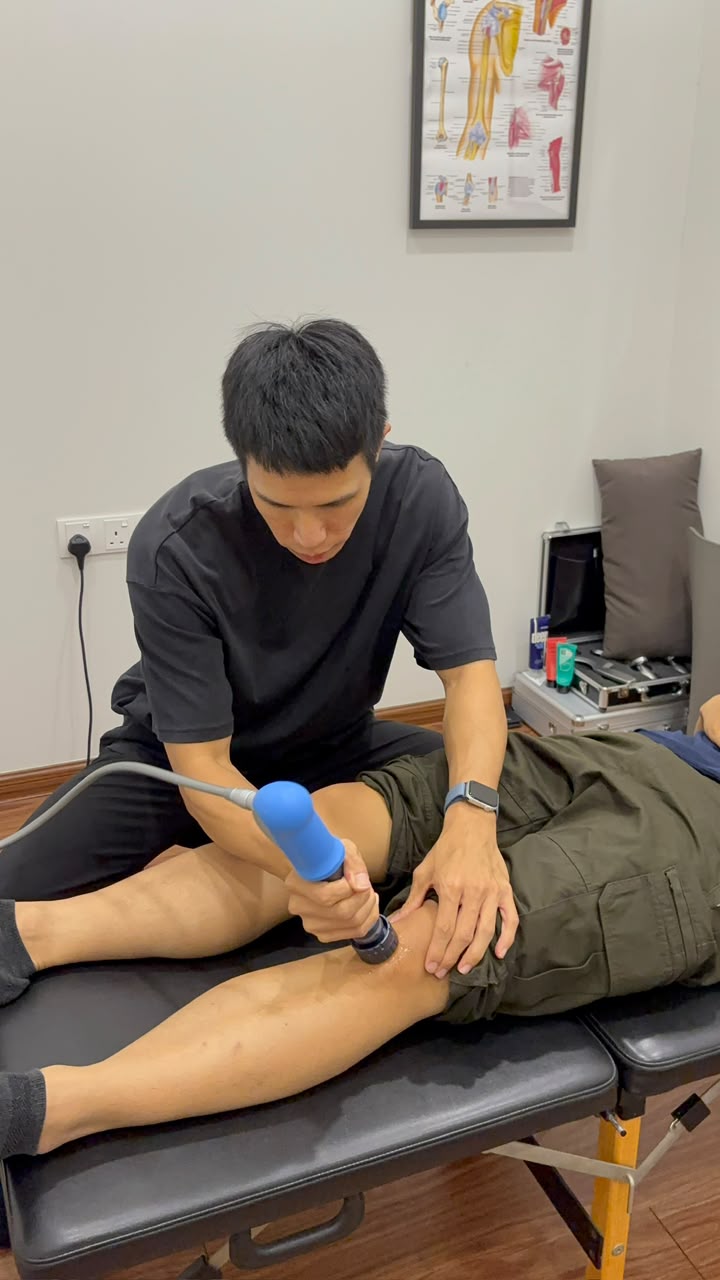
How it works: A handheld applicator transmits precisely calibrated pressure waves through the skin, reaching depths unreachable by surface-level therapies, without a single incision.
Radial versus focused waves represent an important clinical distinction. Radial waves disperse energy outward from the skin surface, making them effective for broader muscle groups and superficial tissue. Focused waves concentrate energy at a specific depth, which tends to work better for targeting deep lumbar structures, disc-adjacent tissue, and stubborn calcifications. According to research published in a study published in Frontiers in Medicine, ESWT has demonstrated meaningful clinical outcomes for chronic musculoskeletal conditions, with FDA clinical data showing pain score reductions of 60% or greater in eligible patients.
Not all shockwave devices, however, are engineered to deliver this level of clinical precision — and that distinction matters enormously for real-world outcomes.
Why Swiss Dolorclast is the Gold Standard for KL Patients
Not all shockwave devices deliver what chronic back pain actually demands — and for patients seeking shockwave therapy for lower back pain in Kuala Lumpur, the technology behind the treatment matters as much as the treatment itself.
A critical distinction exists between true shockwave devices and low-power "vibration" tools that superficially resemble them. Many devices marketed as shockwave therapy generate mild percussive vibrations that reach only superficial tissue layers. They may feel intense, but they lack the pressure amplitude needed to stimulate genuine cellular repair at depth. As Dunbar Medical notes, patients who do not see results from shockwave therapy often received treatment from underpowered equipment — not from the modality itself failing.
The Swiss DolorClast® system sits in a different category entirely. It is one of the most rigorously studied radial shockwave platforms in clinical medicine, with a PEDro-analyzed body of research showing that 80% of clinical studies confirm it delivers superior outcomes compared to control groups. That is not a marketing claim — it is a reproducible finding across independent trials.
"The Swiss DolorClast® is one of the only shockwave systems with a validated energy output protocol, meaning clinicians can deliver consistent, measurable therapeutic doses — not estimates."
This consistency is particularly valuable for sports injuries and severe postural strain, where tissue damage is concentrated, layered, and resistant to surface-level intervention. Precise energy delivery allows the device to penetrate fascial adhesions and calcified deposits that build up in conditions like chronic lumbar strain or sacroiliac dysfunction — conditions common among KL's desk-bound and physically active populations alike.
On the question of safety, the profile is reassuring. ESWT is non-invasive with minimal side effects — most patients experience only mild localized soreness for 24 to 48 hours post-session. There is no incision, no anesthesia, and no recovery downtime. That combination of clinical rigor and low risk is a key reason why Chiropractic House has earned its reputation as the best shockwave therapy clinic in Kepong — and why the Swiss DolorClast® remains the preferred platform when outcomes genuinely matter. Understanding which patients benefit most from this technology — from postpartum mothers to competitive athletes — brings the picture into sharper focus.
Swiss DolorClast vs. Standard Vibration Therapy
|
Feature |
Swiss DolorClast (ESWT) |
Standard Vibration Tools |
|---|---|---|
|
Energy Type |
High-energy acoustic shockwaves |
Low-power percussive vibration |
|
Depth of Penetration |
Deep (targets lumbar & disc-adjacent tissue) |
Superficial (skin and top muscle layers) |
|
Biological Effect |
Triggers angiogenesis & cellular repair |
Temporary muscle relaxation only |
|
Clinical Evidence |
80% of studies confirm superior outcomes |
Limited to no clinical validation for repair |
|
Primary Use |
Chronic pain & tissue regeneration |
General massage & temporary relief |
From Post-Pregnancy to Post-Marathon: Who Benefits Most?
Shockwave therapy reaches far beyond a single patient type — and understanding who responds best helps you recognize whether it belongs in your recovery plan.
KL mothers recovering from pregnancy often face a combination of pelvic instability and lower lumbar stress that conventional rest simply does not resolve. The connective tissue and ligaments supporting the pelvis remain loosened long after delivery, creating a foundation for chronic lower back dysfunction. Swiss Dolorclast for lower back pain directly stimulates collagen synthesis in these weakened structures, accelerating the tissue remodeling that restores genuine stability rather than masking the pain temporarily. As Laura Valentini shared about her experience with the Swiss DolorClast® system, the therapy proved to be "a game-changer… helping accelerate muscle recovery and build strength in areas that felt weak post-pregnancy" — a finding that research on ESWT outcomes consistently supports.
Athletes and active individuals in Kepong — from weekend warriors logging Saturday runs to gym-goers managing recurring lumbar strain — carry a different burden. Repetitive loading creates micro-tears and scar tissue that restrict movement and compound over training cycles. Shockwave therapy breaks down this scar tissue mechanically, restoring tissue mobility without the downtime that sidelines performance. Combined with chiropractic spinal realignment, athletes often return to full loading capacity faster than with passive rest alone.
Office workers represent arguably the largest underserved group. Prolonged desk posture drives Upper Cross Syndrome — a pattern of tight chest and neck muscles paired with weakened deep stabilizers — alongside chronic lumbar stiffness from sustained hip flexor shortening. Shockwave therapy addresses the myofascial component of this dysfunction, while chiropractic care restores the joint mobility that sitting compresses over years. Together, the two modalities correct both the soft tissue and the structural contributors — which is exactly why the best shockwave therapy clinic in Kepong pairs them rather than offering either in isolation.
This combined approach matters because back pain rarely has a single origin. If you are ready to see how a session actually unfolds, the next section walks through exactly what to expect from your first appointment.
What to Expect: Your First Shockwave Session in Kepong
Knowing exactly what happens during a shockwave session removes the hesitation that keeps many chronic back pain sufferers on the sidelines. Your first appointment with Swiss Dolorclast for lower back pain is more structured — and more straightforward — than most patients anticipate.
The process generally follows four clear stages:
-
Consultation and assessment. The practitioner begins by evaluating your pain site, reviewing your history, and testing your range of motion. This step identifies the precise tissue layers driving your symptoms, so the device is calibrated accurately before treatment begins.
-
The treatment itself. A gel is applied to the skin, and the handheld applicator delivers rhythmic pulses directly to the affected area. Most patients describe the sensation as a firm tapping or deep pulsing — noticeable, and occasionally mildly uncomfortable over tender spots, but entirely tolerable. Honesty matters here: it is not painless, but it is not sharp or prolonged either.
-
Duration and frequency. Each session runs approximately 15 to 20 minutes. A standard course involves three to five sessions spaced about a week apart, allowing tissue repair to progress between visits.
-
Post-session care. Mild soreness for 24 to 48 hours is normal and signals that biological repair has been triggered. According to Mayo Clinic, many patients notice meaningful pain reduction after just the first session, with cumulative improvement building across the full course.
Research published in a study published in Frontiers in Medicine confirms that combining shockwave with conventional physical therapy produces significantly better outcomes than either treatment alone — which points directly to why the next question most patients ask is whether this approach is the right fit for their specific situation.
Frequently Asked Questions About Back Pain Shockwave Therapy
Is shockwave therapy better than a cortisone injection?
While cortisone provides rapid temporary relief by suppressing inflammation, it can weaken tendons over time. Shockwave therapy is a regenerative treatment that stimulates the body's natural healing process for long-term repair without the side effects of steroids.
Are there any downsides or side effects?
Side effects are minimal and typically resolve within 36 hours. Some patients experience mild redness, swelling, or temporary localized discomfort as the biological healing response begins.
Where should shockwave therapy not be used?
Shockwave therapy should not be applied directly over the lungs, large blood vessels, nerves, or the abdomen during pregnancy. A professional assessment at our Kepong clinic ensures the treatment is applied safely and effectively.
The Bottom Line: Is Shockwave Therapy Right for You?
Shockwave therapy is no longer an experimental option — it is a clinically-backed, non-surgical solution that delivers measurable results for people living with chronic back pain. For anyone weighing a non-invasive back pain treatment KL residents can realistically access, the evidence is difficult to ignore. According to U.S. Food and Drug Administration data on Swiss DolorClast® studies, 61% of subjects met the success criterion of a 60% reduction in pain scores — a threshold that many pharmaceutical and passive therapy approaches rarely reach consistently.
Not all shockwave devices deliver equal results. As covered earlier, Swiss DolorClast technology operates at higher energy output than generic wave devices, penetrating deeper tissue layers where chronic inflammation and scar tissue typically resist surface-level treatment. Real clinical shockwave therapy differs fundamentally from massage-style wave devices — and that distinction directly affects whether you experience lasting relief or short-term placebo comfort.
The therapy also performs best when integrated with professional chiropractic adjustments. This 'Mechanical + Biochemical' approach ensures that while chiropractic care restores spinal alignment and relieves nerve pressure, shockwave therapy addresses the soft tissue component—breaking down adhesions and accelerating cellular repair. This synergy makes adjustments easier to perform and significantly longer-lasting.
Clinical backing: 61% of patients achieved ≥60% pain reduction in Swiss DolorClast® trials
-
Technology matters: Swiss DolorClast outperforms generic devices in energy delivery and tissue depth
-
Combined care wins: Shockwave plus chiropractic adjustments addresses both soft tissue and spinal structure
-
Local access: Kepong's Chiropractic House offers this specialized combination under one roof
For patients in KL, Chiropractic House in Kepong brings this specialized combination together in a single clinic. That accessibility matters — because the right technology, when applied by trained professionals, is what separates genuine recovery from temporary relief. The next step is closer than you might think.
Quick Summary: Shockwave Therapy for Back Pain
What it is: A non-invasive treatment using high-energy acoustic waves to trigger biological repair in damaged back tissue.
The Swiss DolorClast Advantage: Unlike generic vibration tools, it is clinically proven to penetrate deep tissue, with an 80% success rate in clinical studies for superior outcomes.
Key Benefits: Reduces chronic inflammation, breaks down painful scar tissue (adhesions), and stimulates new blood vessel growth (angiogenesis).
Treatment Plan: Typically involves 3–5 sessions (15–20 minutes each) at our Kepong clinic, often paired with chiropractic adjustments for structural alignment.
Recovery: Zero downtime; most patients return to daily activities immediately, with significant pain reduction often felt within 4–12 weeks.
Take the First Step Toward a Pain-Free Life in Kuala Lumpur
Chronic back pain is not a price you must pay for living and working in Kuala Lumpur — and Swiss Dolorclast shockwave therapy at Chiropractic House proves exactly that.
You do not have to accept pain as your baseline. Many KL residents endure prolonged discomfort because no single treatment has delivered lasting relief. What consistently produces better outcomes is a clinical approach that combines the precision of Swiss Dolorclast technology with hands-on, Tecar-assisted manual therapy — addressing not just the symptom, but the structural reasons pain keeps returning. For anyone exploring shockwave therapy for lower back pain in Kuala Lumpur, Chiropractic House offers one of the most clinically rigorous and fully integrated options available.
Chiropractic House, a leading wellness clinic serving Kepong and KL, brings that exact combination under one roof. The treatment is entirely non-invasive and drug-free, meaning you avoid the side effects of long-term medication and the risks of surgical intervention. In practice, most patients require no downtime and can return to their daily routines almost immediately after each session.
Taking the next step is straightforward. Book a consultation at Chiropractic House, where the clinical team will assess your specific condition and determine whether shockwave therapy is the right fit for your recovery. Your journey to confident, pain-free movement begins with a single appointment — and that appointment could be the turning point your back has been waiting for.


