
Most neck and back pain in Malaysian schoolchildren is mechanical — load and posture held too long — and it settles. Two culprits get blamed: the school bag and the phone. The evidence behind each is weaker than the headlines suggest, though both are worth managing. What matters more is recognising the small number of symptoms that mean a child needs a doctor rather than a posture lecture.
This is for parents in Segambut, Mont Kiara, Sri Hartamas, Dutamas and Kepong whose child has a sore neck or back.
What the Malaysian school bag rule actually says
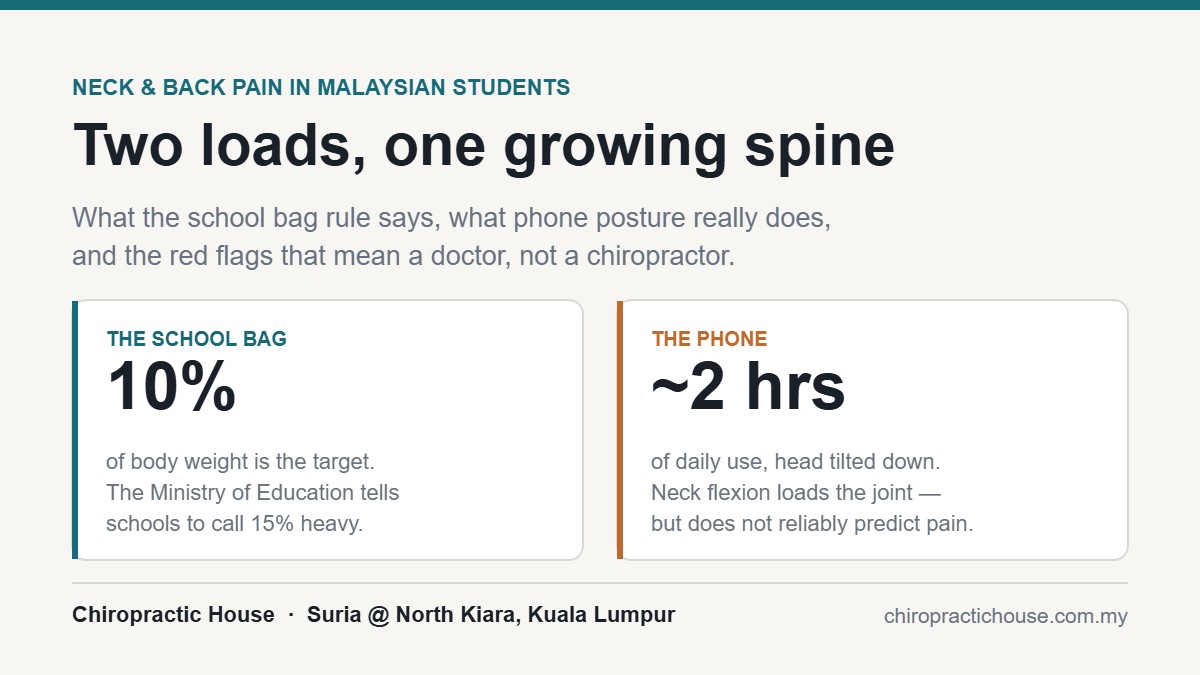
In a circular dated 12 September 2018, the Ministry of Education instructed schools to prepare posters defining a heavy bag as 15 per cent of a student’s body weight. The more commonly quoted target is 10 per cent. Treat 10 as what you aim for and 15 as the line you should not cross.
The most useful finding in that circular is not the percentage. Based on the ministry’s own 2017 study, MoE textbooks and activity books account for only about 28 per cent of the total bag weight when packed to the daily timetable. The other 72 per cent is extra books, dictionaries, comics, water bottles, food containers and sports attire. The ministry also discouraged trolley bags, citing their own weight and potential shoulder problems (full breakdown of the circular).
A study of 81 primary schoolchildren in Kajang, Selangor, published in the Malaysian Journal of Public Health Medicine, found 74.1 per cent carried bags heavier than 10 per cent of body weight, and 32.1 per cent reported back pain. That is a small, single-district, cross-sectional sample: it shows an association in Malaysian children, not that the bag caused the pain.
What the phone actually does to a teenager’s neck
Here the biomechanics are clear and the clinical picture is not. According to research indexed on PubMed, a modelling study in Ergonomics found that flexing the neck to 45 degrees roughly doubles compression through the cervical spine and increases forward shear in the upper cervical spine about fourfold (DOI: 10.1080/00140139.2019.1677944). A second Ergonomics study tracked 31 students with wearable sensors and found a median of about 126 minutes of daily phone use, with head-down tilt beyond 30 degrees far more common while the phone was in hand (DOI: 10.1080/00140139.2018.1544379).
So the load is real. But loading a joint is not the same as hurting. A study of 582 people in Spine measured cervical flexion angles while participants actually texted and found no association between text neck posture and the prevalence, frequency or intensity of neck pain (DOI: 10.1097/BRS.0000000000003854). That was an adult sample, so it does not settle the question for teenagers — but it should make anyone cautious about blaming a child’s posture as though it explained everything. A 2025 scoping review in the Journal of Clinical Medicine found exercise, postural correction and manual therapy in combination helped text neck symptoms, but 93 per cent of those studies were in adults and the authors flagged the near-absence of paediatric research (DOI: 10.3390/jcm14041386).
Bag versus phone: how the two compare
| Heavy school bag | Phone posture (“text neck”) | |
|---|---|---|
| Type of load | External weight, mostly shoulders and lower back | Sustained neck flexion, no external weight |
| Duration | Short — the walk to the car, assembly, stairs | Long — about two hours a day, in repeated bouts |
| Malaysian data? | Yes, though small and cross-sectional | None found; overseas studies only |
| Link to pain | Association shown in local schoolchildren | Load shown; direct link to pain not established |
| Easiest fix | Pack to the timetable — most weight is optional | Raise the phone, shorten the bout |
Red flags — when this is not a posture problem
Take your child to a doctor, not a chiropractor, if any of the following apply. Neck and back pain in children is usually harmless, but the exceptions matter more than in adults.
- Pain that wakes the child at night, or is worse lying down than standing
- Fever, unexplained weight loss or night sweats alongside the pain
- Pain that started after a fall, a tackle or a road accident
- Weakness, numbness or pins and needles in an arm or leg, or a change in walking
- Any change in bladder or bowel control
- A head held fixed to one side that came on suddenly, especially with fever
- Morning stiffness lasting more than about 30 minutes, or swollen joints
- Constant pain in a younger child that does not vary with activity
For anything on that list, start with your GP or the nearest Klinik Kesihatan. For sudden weakness, loss of bladder or bowel control, or pain after significant trauma, go to an emergency department — Hospital Kuala Lumpur on Jalan Pahang is the main government hospital serving central KL.
What actually helps, in a Malaysian school week
The bag
- Weigh it once on the bathroom scale, with and without the bag. That gives you a number rather than an argument.
- Pack to the timetable, the night before. Only about a quarter of the weight is required books.
- Both straps, worn short, so the bag sits high with the weight close to the spine.
- Ask about lockers or leaving reference books in class — the 2018 circular encouraged this.
The phone and the desk
- Raise the phone, not the head — at chest height rather than in the lap.
- Break the bout, not the habit. A position held for 40 minutes is the problem, not the position. Standing every 20 to 30 minutes beats nagging about posture.
- Count the sitting hours. A KL secondary student may sit through six hours of school, two of tuition and two of homework. That is the real exposure, and it peaks before SPM.
- Protect the movement. Afternoon heat pushes activity indoors; badminton courts and a walk after dinner both count.
For a teenager training seriously in a racquet or field sport, sports massage can help with tightness and recovery — an adjunct to load management, not a substitute.
Who to see, and under which law
In Malaysia, chiropractic is one of seven practice areas recognised under the Traditional and Complementary Medicine Act 2016 (Act 775), regulated by the T&CM Council under the Ministry of Health. Physiotherapy sits elsewhere, under the Allied Health Professions Act 2016 (Act 774). Different registers, different scopes — we set the distinction out in chiropractor versus physiotherapist in Malaysia.
For a child the sensible order is usually: rule out the red flags with a GP or Klinik Kesihatan first, then consider manual care if the picture is straightforwardly mechanical. A chiropractic adjustment is only one possible outcome of an assessment — sometimes the answer is exercise, sometimes a referral, sometimes just changing what goes in the bag.
Two honest limits: chiropractic care does not cure scoliosis, and it does not permanently change posture. It can help with mechanical neck and back pain and give a family a clear explanation. Anything beyond that is a claim worth questioning.
What an assessment costs in Kuala Lumpur
A first consultation at Chiropractic House costs RM250 to RM410, depending on what the assessment involves; follow-ups cost less. We are a cash-pay clinic and do not bill insurers directly, but we issue receipts and clinical documentation for patients who wish to claim themselves — see our guide to chiropractic insurance coverage in Malaysia.
The clinic is at Suria @ North Kiara, off Jalan Kuching — a short drive from Segambut, Dutamas, Mont Kiara, Sri Hartamas and Kepong. To discuss whether an assessment suits your child, get in touch.
Frequently asked questions
How heavy should my child’s school bag be?
Aim for 10 per cent of body weight; treat the ministry’s 15 per cent as the ceiling. Weigh it rather than guessing — Malaysian research found three in four primary schoolchildren over the 10 per cent mark.
Is “text neck” a real medical diagnosis?
No. It describes a posture, not a disease, and has no formal diagnostic criteria. The posture measurably increases load on the cervical spine, but the largest study to measure texting posture directly found no association with neck pain. Useful shorthand for a habit worth changing — nothing more.
Can a chiropractor treat a teenager?
Chiropractors registered with the T&CM Council under Act 775 manage musculoskeletal complaints, and adolescents fall within that scope. But the research on manual care in under-18s is thin — the scoping review above found 93 per cent of text neck studies were in adults. Any practitioner seeing a minor should screen for red flags, involve a parent, and refer out where the picture is not clearly mechanical.
Does my child need an X-ray?
Usually not. For uncomplicated mechanical pain in a growing child, imaging rarely changes what you do and carries a radiation cost. It is guided by red flags — trauma, neurological signs, systemic symptoms, night pain — and that decision belongs with a doctor.
My child’s neck started hurting in the run-up to SPM. Is stress a factor?
Possibly, though not in isolation. Exam periods change several things at once: more hours seated, less sport, later nights, worse sleep. Rather than treating stress as the diagnosis, look at what changed in the routine. If pain has not improved after two to three weeks, or is keeping your child from school or sport, have it assessed.
Medical disclaimer: This article is general information, not medical advice, diagnosis or treatment, and is no substitute for an in-person assessment. If your child has any of the red flag symptoms above, seek medical attention promptly.
Written by Eugene Gan, Chiropractor, Bachelor of Science (Hons) Chiropractic, accredited by the Council on Chiropractic Education Australasia (CCEA). Chiropractic House, Suria @ North Kiara, Kuala Lumpur.


