
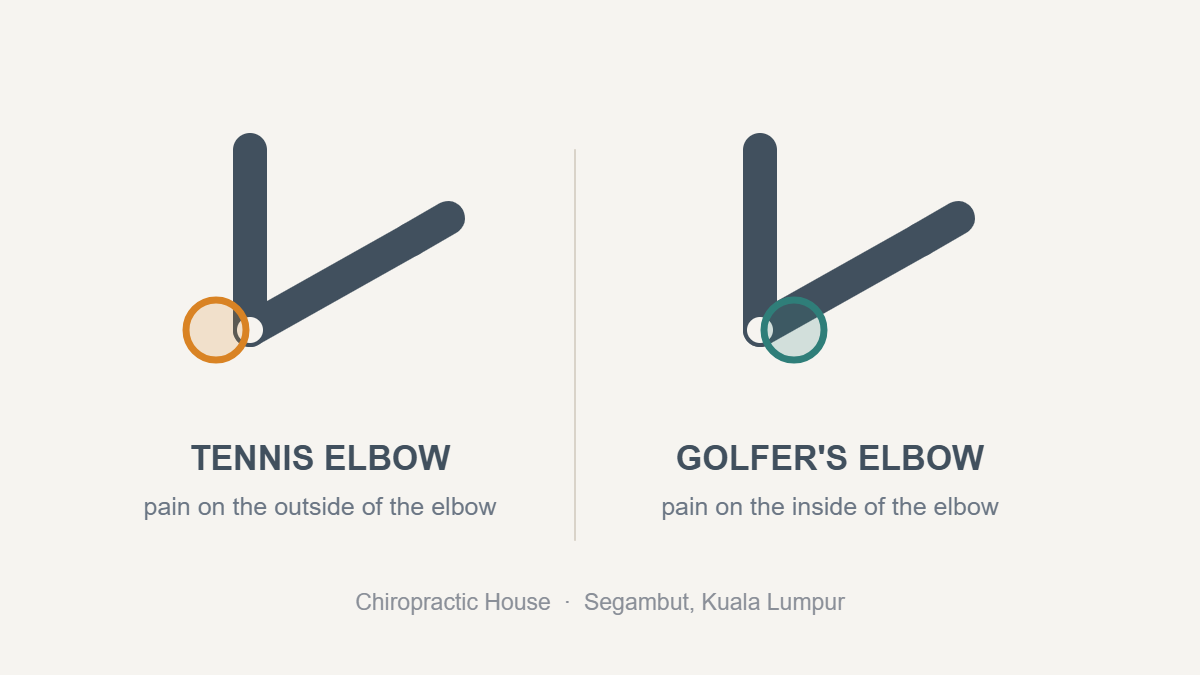
Short answer: tennis elbow hurts on the outside of the elbow, golfer’s elbow on the inside. Both are tendon problems where the forearm muscles attach to the bone, both are driven by load rather than by anything being out of place, and both usually settle — slowly, and generally only once you change what the arm does all day. The clearest finding in the research is an uncomfortable one: a steroid injection makes the elbow feel much better this month and measurably worse a year later.
Where it hurts tells you which one it is
Tennis elbow, or lateral epicondylalgia, affects the tendons of the muscles that lift the wrist and fingers backwards, which attach to the bony bump on the outside of the elbow. Golfer’s elbow, or medial epicondylalgia, affects the muscles that bend the wrist and grip, which attach to the bump on the inside.
Neither name is much use here. In Kuala Lumpur, tennis elbow comes far more often from a mouse, a badminton racket or a screwdriver than from tennis, and golfer’s elbow from carrying, gripping and pulling. It is also about three times as common: a Finnish study of 4,783 working-age adults found definite lateral epicondylitis in 1.3% and medial in 0.4%, peaking between 45 and 54 (Shiri et al., American Journal of Epidemiology, 2006).
| Tennis elbow | Golfer’s elbow | |
|---|---|---|
| Where the pain sits | Outside of the elbow | Inside of the elbow |
| Worst when you | Grip, lift a kettle, shake hands, hit a backhand | Grip hard, pull, carry, hit a smash or forehand |
| Tender to press on | The bony bump on the outside | The bony bump on the inside |
| Common local triggers | Mouse, badminton backhand, hand tools, a new gym programme | Carrying, deadlifts and pull-ups, smashes, manual trades |
| How common | About 1.3% of working-age adults | About 0.4% |
| What usually happens | Months, not weeks. In trials most people are recovered or much improved by 12 months | |
Why so many Kuala Lumpur elbows hurt
Two groups turn up with it. Desk workers — the offices around Mont Kiara, Sri Hartamas, Dutamas and Segambut are full of people who spend nine hours with one hand on a mouse. And badminton players: walk past the halls off Jalan Kuching on a weeknight and every court is taken. Often the same people.
Repetition on its own is not usually the problem. In the Finnish data, repetitive arm movement and forceful activity together carried an odds ratio of 5.6 for possible or definite lateral epicondylitis, far more than either alone; smoking was an independent risk factor for tennis elbow, and smoking, obesity, repetition and force each independently raised the risk of golfer’s elbow. Repeated and forceful describes a backhand clear, a heavy carry from the car park, and a full day of mouse work followed by two hours on court — a very ordinary Klang Valley week.
Grip size and string tension matter for the same reason: anything that makes you squeeze harder loads these tendons harder. The elbow is the one joint left out of the article on badminton injuries in Malaysia, which covers the knee, ankle and shoulder.
What the evidence says helps — and what makes it worse
Tennis elbow has been studied properly. Two Australian randomised trials shape how most of us treat it.
In the first, 198 people were assigned to eight sessions of physiotherapy combining elbow manipulation and exercise, a corticosteroid injection, or wait and see. The injection group did best at six weeks, then fell apart: 47 of 65 successful outcomes later regressed, and by 52 weeks that group had done significantly worse than the physiotherapy group. Most people in the physiotherapy and wait-and-see groups reported a good outcome at a year (Bisset et al., BMJ, 2006).
The second was placebo-controlled and blinded. Among 165 people with chronic tennis elbow, 83% of those given a corticosteroid injection were recovered or much improved at one year, against 96% given a placebo injection; recurrence was 54% after steroid and 12% after placebo (Coombes et al., JAMA, 2013). Physiotherapy made no significant difference at one year there, though it helped early on in those who had not had a steroid.
Read together: time and sensible load management do most of the work. Hands-on treatment and exercise mainly buy earlier relief and less need for painkillers. A steroid injection, still routinely offered, is a poor trade unless you need six weeks of relief for a specific reason.
Where shockwave therapy fits
A 2024 meta-analysis of six randomised trials compared shockwave therapy with corticosteroid injection in chronic tennis elbow. Shockwave was worse at one month, better at three and six months for pain and grip strength, with similarly low rates of mild side effects (Zhang et al., Orthopaedic Surgery, 2024). The trials were small and involved chronic symptoms, so this is not an argument for shockwave in an elbow that started hurting last week — but it is a reasonable option for one that has not shifted in three months. More on what shockwave therapy is.
The evidence for dry needling and sports massage in elbow tendinopathy is thinner. Both may ease the forearm muscles feeding the painful tendon; neither should be sold to you as the fix.
Red flags — see a doctor rather than a chiropractor
Most elbow pain is a tendon problem. Some is not. Do not book manual treatment first if any of these apply.
- Pain straight after a fall or direct blow, especially with visible deformity or an inability to straighten the arm
- A hot, red, swollen joint, particularly with fever or feeling generally unwell
- Numbness, pins and needles or weakness into the hand — especially the ring and little fingers, which points to the ulnar nerve rather than a tendon
- Grip that is rapidly getting weaker, or a hand that drops things
- Pain that wakes you at night for no mechanical reason, or comes with unexplained weight loss
- Sudden severe pain and a change in the shape of the muscle after a heavy lift, which can mean a tendon rupture
- Worsening pain, swelling or fever in the days after any injection into the elbow
For anything urgent in this part of the city, Hospital Kuala Lumpur on Jalan Pahang runs a 24-hour emergency department, and there are private emergency departments closer to Segambut and Mont Kiara. A suspected fracture, an infected joint or a ruptured tendon is a hospital problem.
What chiropractic care can and cannot do for an elbow
Chiropractic care does not cure tennis elbow or golfer’s elbow. Nothing does, quickly. An assessment can work out which tendon is involved, check whether the neck and shoulder are changing how the arm is loaded, and rule out the nerve and joint problems that mimic tendon pain. A chiropractic adjustment may help a stiff neck or mid-back; it does nothing directly to a tendon at the elbow.
The treatment that consistently helps is progressive loading of the tendon — gradual, boring, done by you, over months. If your plan is mostly exercise prescription, a physiotherapist may be the better fit; the two professions do genuinely different things here, as set out in chiropractor versus physiotherapist. If nothing has shifted after six months of good conservative care, an orthopaedic or hand surgeon is the next conversation.
How this is regulated in Malaysia
Chiropractic is one of seven practice areas recognised under the Traditional and Complementary Medicine Act 2016 (Act 775), regulated by the T&CM Council under the Ministry of Health (MOH Traditional and Complementary Medicine Division). Physiotherapy sits under a different law, the Allied Health Professions Act 2016 (Act 774). The two are separately trained, registered and scoped — ask whoever you see about their registration.
What an assessment costs
At Chiropractic House in Suria @ North Kiara, off Jalan Kuching in Segambut, a first session is RM250 to RM410 depending on what the assessment and treatment involve. Follow-ups cost less. We are a cash-pay clinic and do not bill insurers directly, but we issue receipts and clinical documentation for patients claiming themselves — see chiropractic insurance coverage in Malaysia.
Frequently asked questions
Do I have to stop playing badminton, or stop using a mouse?
Almost never completely. Total rest tends to leave tendons weaker and no less painful. Reduce the peaks instead — shorter sessions, doubles instead of singles for a few weeks, a break every 40 minutes at the desk, and a temporary stop on the one movement that reliably reproduces the pain.
Should I get a steroid injection?
That is a conversation for you and a doctor, but go into it knowing the trial data above: better at six weeks, worse at one year, recurrence in roughly half. Routine first-line use is hard to justify.
Do I need an X-ray, ultrasound or MRI?
Usually not. Both conditions are diagnosed clinically. Imaging is for red flags, a suspected fracture or rupture, symptoms that do not fit, or a decision about surgery. Scans of painless elbows often show tendon changes anyway, which can mislead.
How long is this going to take?
Longer than you want. In the trials above most people were recovered or much improved at 12 months, and some were still improving after that. Anyone promising a fix in three sessions is selling something.
If it has been going on more than a few weeks
An elbow that has hurt for three weeks and is not improving is worth assessing, mostly so you know which tendon it is and what to stop doing. You can get in touch with the clinic. If any of the red flags above apply, go to a hospital first.
Medical disclaimer: this article is general information, not a diagnosis or a treatment plan. Elbow pain has several causes and some of them are serious. Please see a qualified healthcare professional about your own symptoms, and seek urgent medical care if any of the red flags described above apply to you.
Written by Eugene Gan, Chiropractor, Bachelor of Science (Hons) Chiropractic, accredited by the Council on Chiropractic Education Australasia (CCEA). Chiropractic House, Suria @ North Kiara, off Jalan Kuching, Kuala Lumpur.


