
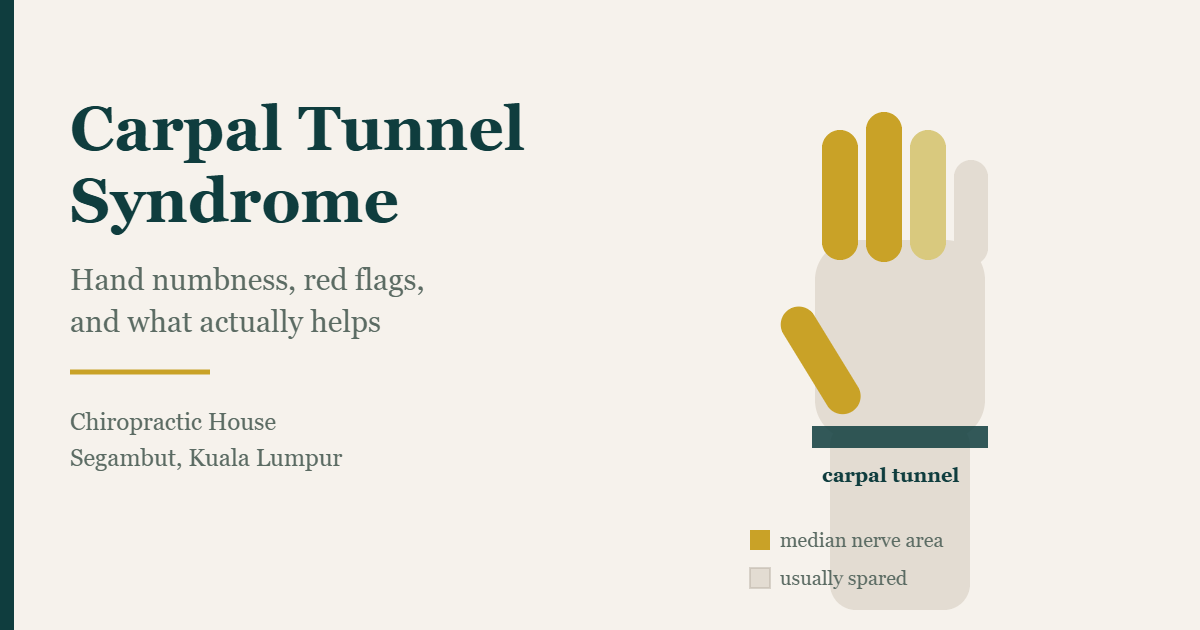
If you wake at two in the morning shaking your hand because the thumb, index and middle finger have gone numb, that one detail tells a clinician more than most scans would. Carpal tunnel syndrome is compression of the median nerve where it passes through a tight channel at the wrist. It is diagnosed from your history rather than from imaging, and waiting too long causes damage that does not fully come back.
The short answer: numbness and tingling in the thumb, index, middle and thumb side of the ring finger, worse at night, eased by shaking the hand, little finger spared. Mild intermittent cases often settle with a night splint and changes to how the hand is loaded. Constant numbness, weakness or visible wasting at the base of the thumb needs a doctor rather than a chiropractor, and needs one soon.
What it actually is
The carpal tunnel is a narrow passage on the palm side of the wrist, roofed by a stiff ligament and shared by nine flexor tendons and the median nerve. When the contents swell, the nerve is the softest structure in there and complains first. It supplies the thumb, index, middle and thumb side of the ring finger, which is why the symptom map is so specific. The little finger runs on the ulnar nerve and is normally untouched.
Around 55 to 65 per cent of cases affect both hands, and the condition is associated with diabetes, hypothyroidism, rheumatoid arthritis and late pregnancy, according to a review in the British Journal of General Practice. If you have one of those, say so to your doctor. The underlying condition often matters more than the wrist.
Who gets it in Kuala Lumpur
Malaysian data is thin but it exists. A Universiti Putra Malaysia study of 100 frontline counter staff at a Klang Valley telecommunications company found 63 per cent reported carpal tunnel symptoms on screening. That figure is high and the authors say so themselves: it came from a questionnaire plus Phalen’s test, not nerve conduction studies, so it measures symptoms rather than confirmed diagnoses. An earlier Malaysian study of government servants using visual display units, cited in the same paper, reported 18 per cent. Both are in the Human Factors and Ergonomics Journal.
The people who come through the clinic in Segambut with median nerve symptoms are a mixed group: counter staff, office workers from Mont Kiara and Sri Hartamas, hairdressers, kitchen staff gripping and wringing all shift, riders on a throttle all day. That same study found no association between workstation ergonomics scores and symptoms, which fits the wider literature: forceful, repetitive hand use and vibration matter more than the height of your monitor.
Red flags: see a doctor, not a chiropractor
- Constant numbness that no longer comes and goes.
- Weakness or clumsiness you can notice, such as dropping a cup or struggling to turn a key.
- Visible hollowing of the pad at the base of the thumb compared with the other hand: thenar wasting, meaning motor fibres are already affected.
- Numbness after a fall, with swelling or deformity, which may mean a fracture.
- A hot, red, swollen wrist with fever, which needs same-day assessment.
- Numbness in both hands and both feet, pointing away from the wrist towards a general nerve problem such as diabetic neuropathy.
The British Journal of General Practice review is direct about the first three: early surgical referral is appropriate where there is constant altered sensation, muscle wasting or weakness of thumb abduction, to prevent irreversible nerve damage. If that describes your hand, the next step is your GP or a Klinik Kesihatan, with a view to an orthopaedic or hand surgery referral.
Is it carpal tunnel, or something else?
Several things get called carpal tunnel that are not. Which fingers are involved, and whether the complaint is numbness or pain, usually separates them.
| Condition | Where you feel it | Worse when | The giveaway |
|---|---|---|---|
| Carpal tunnel syndrome | Thumb, index, middle, thumb side of ring finger | At night, driving, holding a phone | Shaking the hand relieves it; little finger spared |
| Cervical radiculopathy | A band down the arm, often with neck or shoulder ache | Looking up, turning the head | Changes with neck position, not wrist position |
| Cubital tunnel (ulnar nerve at the elbow) | Little finger and that side of the ring finger | Leaning on the elbow, sleeping elbow-bent | The opposite finger pattern |
| De Quervain’s tenosynovitis | Thumb side of the wrist, no numbness | Lifting a baby, wringing a cloth | Pain rather than numbness |
| Thumb base osteoarthritis | Deep ache at the base of the thumb | Gripping, opening jars | Stiffness, sometimes a squared-off joint |
A neck-driven problem is common enough in desk workers to be worth ruling out, particularly alongside the stiff neck described in our piece on text neck. Elbow pain without numbness is covered in tennis elbow versus golfer’s elbow.
How it is assessed in Malaysia
UK guidance is explicit that nerve conduction studies are not needed for classic symptoms; they are for diagnostic uncertainty, pre-surgical planning and medico-legal cases. In Malaysia they run through neurology and orthopaedic services at government and teaching hospitals, usually by GP or Klinik Kesihatan referral, and at private hospitals across the Klang Valley on a self-pay or insured basis.
What the evidence says actually helps
Being straight about this matters. Chiropractic care does not cure carpal tunnel syndrome, and no manual therapy decompresses a carpal tunnel in any permanent sense.
Night splinting holds the wrist near neutral overnight and is the standard first step for mild to moderate symptoms with no wasting or weakness. Evidence for splints is limited, but the practical rule in primary care guidance is that benefit should show within about eight weeks. Wrist supports are sold at most Malaysian pharmacies for well under RM100.
Corticosteroid injection has Cochrane support for short-term improvement, with effects beyond three months uncertain. Surgical decompression is considered where symptoms are severe or constant, the deficit is progressive, or three months of conservative treatment has not helped. Both are doctor territory.
Manual therapy and nerve-gliding techniques have been studied. A systematic review on PubMed Central reported improvements in pain and function, but rates that evidence as low certainty because the trials are small and uneven. The short-term signal is positive; confidence in it is not. The same primary care review notes the condition may settle on its own in up to a third of people over 10 to 15 months, so some of what any treatment appears to achieve is natural recovery.
What conservative care can address is load across the chain from neck to wrist, and any neck contribution mistaken for a wrist problem: assessment first, then some combination of chiropractic adjustment where a joint restriction is genuinely present, soft tissue work on the forearm flexors, and modalities such as Tecar therapy or dry needling. It also means saying so when the answer is a splint, a GP or a hand surgeon.
If it is work-related: SOCSO
Carpal tunnel syndrome linked to job tasks can be claimed as an occupational disease under PERKESO’s Employment Injury Scheme. The claim runs on Form 34 through your employer or the nearest PERKESO office and needs a medical report connecting your duties to the condition; see the PERKESO Employment Injury Scheme page. That certification must come from a registered medical practitioner, not a chiropractor, and treatment under the scheme is given at PERKESO panel and government facilities. If you think this is work-related, raise it early.
Who is allowed to treat this here
Chiropractic here is regulated under the Traditional and Complementary Medicine Act 2016 (Act 775) and the T&CM Council, one of seven recognised practice areas, with registration mandatory. Physiotherapy sits under the Allied Health Professions Act 2016 (Act 774) and a different council; the differences are in chiropractor versus physiotherapist in Malaysia. Awareness of this is patchy, as a Klang Valley survey on PubMed Central found, so it is fair to ask any practitioner about registration.
Common questions
Will an X-ray or MRI show carpal tunnel syndrome?
No. The diagnosis is clinical, and an X-ray is used to look for something else such as a fracture or thumb base arthritis. Nerve conduction studies measure median nerve function and are ordered when the diagnosis is uncertain or surgery is planned, not routinely.
Can a chiropractor treat carpal tunnel syndrome?
A chiropractor can assess the hand, wrist, elbow and neck, work out whether this is median nerve compression at the wrist or something referred from the neck, and treat the musculoskeletal contributors. The evidence is positive short-term but low certainty. It does not replace a splint, injection or surgery where those are indicated, and it is the wrong choice if there is thumb muscle wasting.
What does an assessment cost at Chiropractic House?
A first session is RM250 to RM410 depending on what is involved, and follow-ups cost less. We are at Suria @ North Kiara, off Jalan Kuching, a short drive from Segambut, Dutamas, Mont Kiara and Sri Hartamas. We are cash-pay and do not bill insurers directly, but we issue receipts and clinical documentation if you want to claim yourself. More in our guide to insurance coverage in Malaysia.
Should I just buy a wrist splint from the pharmacy?
For mild, intermittent, night-time symptoms with no weakness and no wasting, a night splint is a sensible low-risk first step. Wear it at night rather than all day and give it eight weeks. If nothing changes, or symptoms become constant, get assessed.
Does typing cause it?
Less than most people assume. The Malaysian counter-worker study found no association with workstation ergonomics scores, and the wider literature points at forceful gripping, highly repetitive hand work and vibration instead. That is why fixing the desk alone often does not fix the hand.
If you are not sure which side of that red flag list you fall on, an assessment will sort it out, and part of that is being told when we are not the right people. Reach us through our contact page.
Medical disclaimer. This article is general information and does not replace an individual clinical assessment. It is not a diagnosis and should not be used to delay medical care. If you have constant numbness, hand weakness, wasting at the base of the thumb, or symptoms after an injury, seek medical attention promptly.
Written by Eugene Gan, Chiropractor, Bachelor of Science (Hons) Chiropractic, accredited by the Council on Chiropractic Education Australasia (CCEA). Chiropractic House, Suria @ North Kiara, off Jalan Kuching, Kuala Lumpur.


