
If your headache starts at the base of your skull, stays on the same side every time, and gets worse after a long stretch at your desk or an hour of stop-start traffic on Jalan Kuching, it may not be a migraine at all. It may be coming from your neck.
The short answer
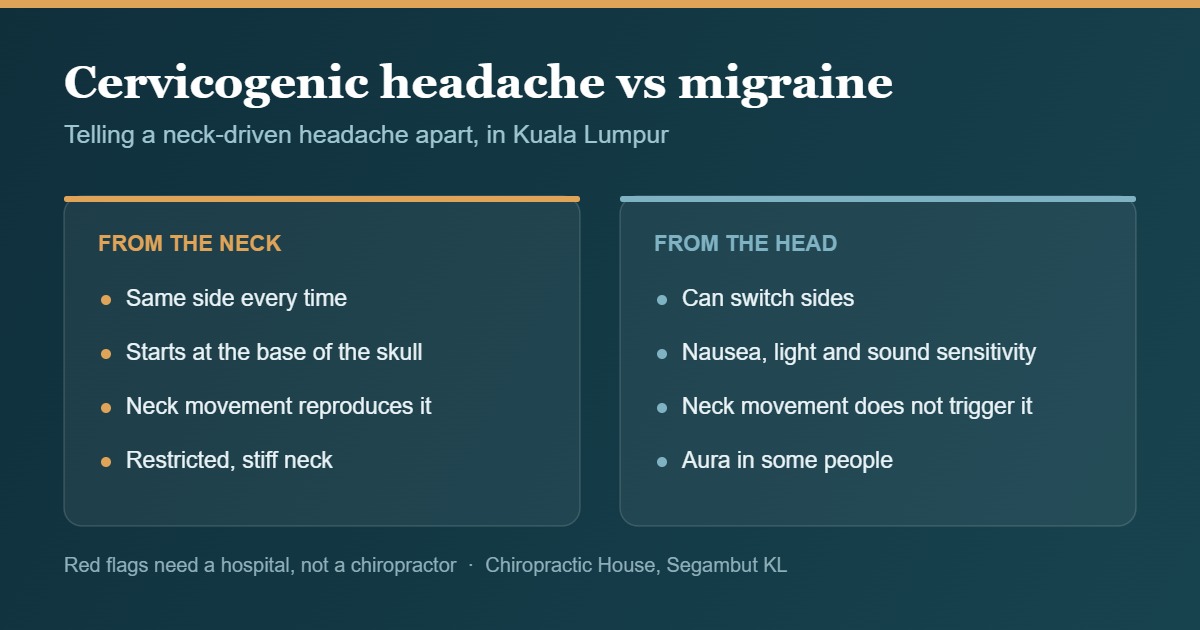
A cervicogenic headache is a secondary headache: the pain is generated in the upper neck and referred into the head. Migraine is a primary headache disorder, where the problem sits in the brain’s own pain pathways rather than in a joint. Cervicogenic headache typically stays on one side, is provoked by neck movement or by pressure on the neck, and comes with a stiff or restricted neck. Migraine more often brings nausea, marked light and sound sensitivity, and can switch sides between attacks.
The distinction matters because manual treatment does something useful for one and very little for the other. If your headaches are migraines, the right person to see is a doctor, not a chiropractor.
What cervicogenic actually means
The International Classification of Headache Disorders (ICHD-3) defines cervicogenic headache as headache caused by a disorder of the cervical spine and its bony, disc or soft-tissue elements, usually but not always accompanied by neck pain. To meet the criteria there has to be evidence of a neck disorder and evidence that the neck is causing the headache: the headache appearing in step with the neck problem, improving as the neck problem improves, or being reliably worsened by provocative neck movements.
Two honest caveats, both taken from the classification itself. First, imaging findings in the upper neck are common in people who have no headaches at all, so an X-ray or MRI showing wear and tear is suggestive at best and proves nothing on its own. Second, the features usually used to spot a cervicogenic headache, such as pain locked to one side, headache reproduced by pressing on neck muscles, and pain spreading from the back of the head forwards, are not unique to it.
That uncertainty shows up in the numbers. Published estimates of how common cervicogenic headache is range from about 4 to 7 per cent of the general population down to 0.17 per cent when strict criteria are applied. A spread that wide tells you the diagnosis is contested, not that one figure is correct.
Cervicogenic headache, migraine and tension-type headache side by side
| Cervicogenic headache | Migraine | Tension-type headache | |
|---|---|---|---|
| Side | Usually one side, and the same side every time | One or both, and can switch sides between attacks | Typically both sides |
| Where it starts | Base of the skull, spreading forwards to the forehead or behind the eye | Often temple or behind the eye, less predictable | A band or pressure around the head |
| The neck | Movement restricted; firm pressure or a sustained position reproduces the headache | Neck pain is common, but neck movement does not reliably reproduce the attack | Mild tightness, rarely restricted |
| Typical triggers | Sustained postures, awkward sleeping position, turning the head | Sleep disruption, hormonal changes, skipped meals, glare, some foods | Stress, fatigue, eye strain |
| Other symptoms | Mild nausea or light sensitivity possible, usually not pronounced | Nausea, vomiting, marked light and sound sensitivity, sometimes aura | Few or none |
| Duration | Hours to days, often continuous and fluctuating | 4 to 72 hours untreated | 30 minutes to several days |
| What tends to help | Manual therapy, neck exercise, changing the aggravating posture | Migraine-specific medication and preventive treatment, prescribed by a doctor | Simple analgesics used sparingly, stress and sleep management |
Real patients do not read the table. Nausea and light sensitivity can appear with cervicogenic headache too, and plenty of people have more than one headache type at once. The table narrows the field; it does not decide the case.
Why neck-driven headaches get missed in Malaysia
There is very little Malaysian data on cervicogenic headache specifically. The main community-based headache study conducted here found a last-year prevalence of 9.0 per cent for migraine and 26.5 per cent for tension-type headache. It is a useful reference point, but it was published in 1996, it predates the current classification, and it did not count cervicogenic headache as a separate category at all. Treat it as background, not as a current figure.
One finding from it is still worth sitting with: more than half of the migraine sufferers attributed their headaches to sun exposure, a tropical pattern you would not see in a European sample. That is what participants believed, not a demonstrated cause. But it shows how readily a headache in this climate gets filed under heat and glare, and a headache filed under the sun never gets its neck examined.
The painkiller trap
Paracetamol and combination painkillers are easy to buy over the counter at any pharmacy in Segambut or Mont Kiara, and most people with recurring headaches work through a lot of them. Under ICHD-3, someone with a pre-existing headache disorder who takes simple analgesics on 15 or more days a month for more than three months can develop medication-overuse headache; for triptans, ergotamine, opioids and combination analgesics the threshold is 10 days a month. A 2025 editorial from headache specialists across Asia-Oceania argues the problem is magnified in low- and middle-income countries in this region, where cheap analgesics are easy to obtain and affordable preventive treatment is not.
No amount of neck treatment will fix a headache that is being sustained by daily painkillers. That is a conversation for your doctor, and stopping abruptly on your own is not the right move either.
Red flags: when a headache needs a hospital, not a chiropractor
Some headaches are warnings. Go to the emergency department of the nearest hospital, not to a manual therapist, if you have:
- a sudden, severe headache that reaches full intensity within about a minute
- headache with fever, a stiff neck, or a rash
- any new neurological sign: weakness, numbness, slurred speech, double or lost vision, confusion, or loss of balance
- headache following a head or neck injury
- headache that is worse lying flat, wakes you from sleep, or worsens with coughing, sneezing or straining
- a first severe headache after the age of 50
- headache during pregnancy or in the weeks after delivery
- headache alongside a history of cancer, or with a weakened immune system
- a headache pattern that keeps changing or is steadily getting worse
These are drawn from the SNNOOP10 list, used by clinicians to screen for secondary headaches. It is a screening prompt rather than a diagnosis, but if one of them applies to you, get assessed medically first.
How a neck-driven headache is assessed
There is no scan and no blood test for this. Assessment is clinical: a history of where the pain starts and what sets it off, then examination of how the upper neck moves, which segments are restricted, and whether firm pressure reproduces your familiar headache rather than simply local soreness. That last point matters. Tenderness is common; reproducing your headache is the finding worth having.
Where muscle trigger points are contributing, dry needling is sometimes used alongside manual work. Where the real driver is a sustained posture rather than the neck itself, as it often is for anyone spending nine hours at a laptop, the treatment that matters most is what you change between appointments. We have written separately about what prolonged forward head posture does, in the context of school bags and Malaysian students.
What the evidence actually shows
A 2022 systematic review and meta-analysis pooled 20 trials covering 1,439 patients with cervicogenic headache. Manual and exercise therapy showed moderate-to-large short-term effects on headache frequency and intensity. But when the analysis was restricted to the trials at low risk of bias, those effects shrank to small, and the authors note that most of the included trials were at high risk of bias.
The honest summary: manual therapy is a reasonable thing to try for a headache that genuinely comes from the neck, the benefit is real but probably modest, and it is strongest in the short term. Chiropractic care does not cure migraine, and it does not cure headaches in general.
Where to get assessed in Kuala Lumpur
Through the public system. Start at your Klinik Kesihatan. If the picture warrants it, the doctor writes a referral letter to a hospital specialist clinic. Hospital Kuala Lumpur’s neurology department runs a dedicated headache clinic on the first Monday morning of each month, alongside its general neurology clinics. It is inexpensive; the wait is the cost.
Privately. A GP is a sensible first stop and can refer you to a neurologist. If the picture is clearly mechanical, meaning the same side every time, provoked by neck position, with a stiff and restricted neck, a manual therapist is a reasonable place to start instead.
Which manual therapist. Chiropractic in Malaysia is regulated under the Traditional and Complementary Medicine Act 2016 (Act 775) through the T&CM Council at the Ministry of Health, and is one of seven recognised T&CM practice areas. Physiotherapy sits under a separate statute, the Allied Health Professions Act 2016 (Act 774), with its own council. We have set out how the two professions differ in Malaysia.
What it costs. At Chiropractic House a first session runs from RM250 to RM410, depending on what the assessment involves; follow-up sessions cost less. We are a cash-pay clinic and do not bill insurers directly, though we issue receipts and clinical documentation if you want to claim yourself, which is covered in our guide to insurance and panel coverage in Malaysia. We are at Suria @ North Kiara, off Jalan Kuching, which puts us within reach of Segambut, Mont Kiara, Sri Hartamas and Dutamas.
Frequently asked questions
Can a chiropractor tell me whether I have migraine?
No. A chiropractor can assess how much your neck is contributing, and can recognise a pattern that does not look mechanical, but diagnosing migraine and prescribing for it is a doctor’s job. If your presentation looks like migraine, the appropriate thing for us to do is say so and refer you on.
Will an X-ray or MRI confirm a cervicogenic headache?
No. ICHD-3 is explicit that imaging findings in the upper neck are common in people without headaches, which makes them suggestive rather than proof. Imaging is useful for ruling other things out, not for confirming this one.
How many sessions should it take?
If the neck is genuinely driving the headache, you should notice some change within the first few sessions. If several weeks of treatment have produced nothing, the honest conclusion is that the neck is not the problem and continuing is not in your interest. Agree a review point before you start.
Is neck treatment safe if I already get headaches?
For most people, after proper screening, yes, and short-lived soreness afterwards is common. Serious complications are rare but not zero, which is why the red-flag screen above comes first and why some people should not be manipulated at all. If any of the warning signs apply, or your headaches have recently changed, see a doctor first. Our page on chiropractic adjustment sets out what an assessment involves.
My headache comes with nausea and light sensitivity. Does that rule out my neck?
Not on its own. ICHD-3 notes that nausea, vomiting and light or sound sensitivity can occur with cervicogenic headache, though generally less intensely than in migraine. It shifts the odds towards migraine without settling the question.
If you are not sure whether your headaches are coming from your neck, get in touch and describe the pattern: which side, where it starts, and what makes it worse.
This article is general information, not medical advice, and does not replace assessment by a qualified clinician. If your headaches are new, changing, or accompanied by any of the red flags above, see a doctor.
Eugene Gan, Chiropractor
Bachelor of Science (Hons) Chiropractic · Accredited by the Council on Chiropractic Education Australasia (CCEA)
Chiropractic House, Segambut, Kuala Lumpur


