
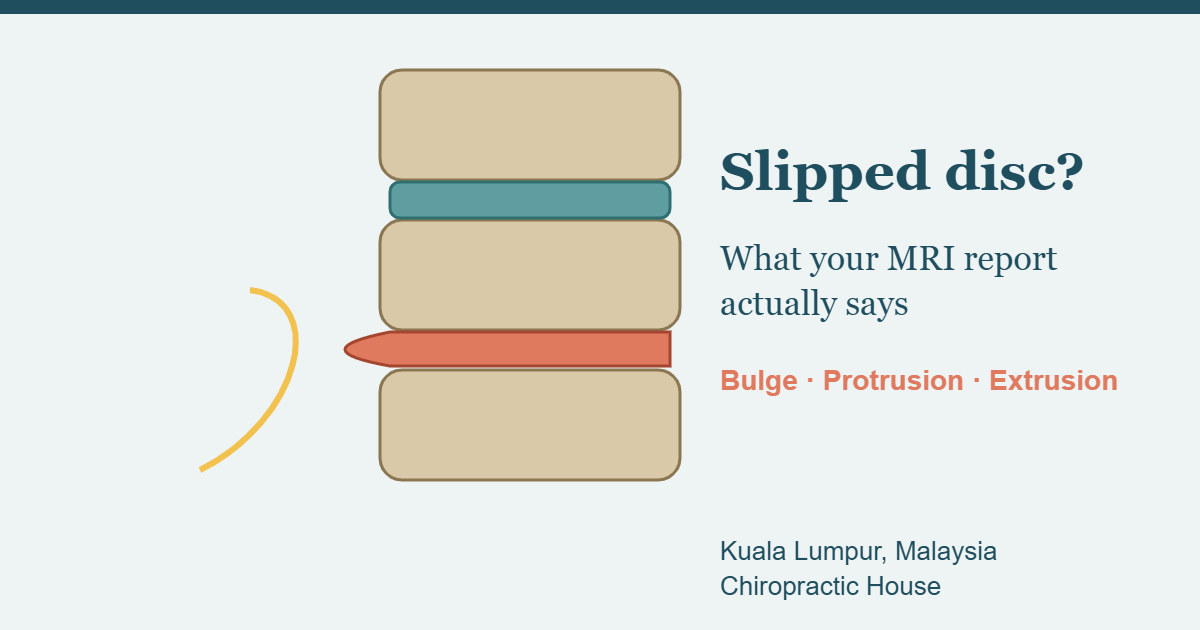
Short answer: “slipped disc” is not a diagnosis. It is everyday shorthand for a spinal disc that has bulged, protruded or ruptured, and the disc has not actually slipped anywhere. Two things are worth knowing before you panic over an MRI report. First, disc changes are very common in people with no pain at all. Second, most herniated discs that do cause pain settle with time and conservative care. The exceptions are a short list of red-flag symptoms, set out below, that need a hospital emergency department the same day.
Red flags: go to an emergency department, not a clinic
Go to the nearest hospital emergency department, government or private, if a suspected disc problem comes with any of these:
- New difficulty passing urine, loss of bladder or bowel control, or being unable to feel when you need to go.
- Numbness in the groin, genitals or inner thighs (the “saddle” area).
- Weakness in one or both legs that is getting worse, such as a foot that drags or a leg that gives way.
- Back or neck pain with fever, unexplained weight loss, a history of cancer, or a recent significant injury.
- Pain that is severe, constant and not eased by any position, especially at night.
The first three can point to cauda equina syndrome, where the nerves at the base of the spinal cord are being compressed. UK guidance says imaging should not be delayed when it is suspected, and that an MRI should be done as an emergency (Academy of Medical Royal Colleges summary of NICE NG59). In Malaysia, emergency cases go straight to a hospital emergency unit and do not need a referral letter.
What a “slipped disc” actually is
Between each pair of vertebrae sits a disc: a tough outer ring with a softer, gel-like centre. The disc is attached to the bones above and below, so it cannot slip out like a book off a shelf. What can happen is that the outer ring bulges, or the inner material pushes through a weakened part of the ring. If that material presses on or irritates a nearby nerve root, you may feel pain, tingling or weakness along the path of that nerve. In the lower back this often shows up as leg symptoms; in the neck, as arm symptoms.
Many people first meet the word in an MRI report, where it is replaced by more precise terms. Those terms matter, because they are not all equally worrying.
Bulge, protrusion, extrusion, sequestration: what the MRI words mean
| Term on the report | What it describes | Chance it shrinks on later scans* |
|---|---|---|
| Disc bulge | The ring extends evenly beyond the edge of the vertebrae; nothing has broken through | About 13% |
| Protrusion | A localised push-out through the ring; the base is wider than the protruding part | About 41% |
| Extrusion | Disc material has broken through and extends beyond its base | About 70% |
| Sequestration | A fragment has separated from the disc and lies free in the spinal canal | About 96% |
*Pooled figures from a 2015 systematic review of spontaneous regression of lumbar herniated discs. Only nine of the 31 studies it found could be used for these calculations, the studies were observational, and “shrinks on a scan” is not the same as “pain has gone”. Treat the numbers as a general direction, not a forecast for your own spine.
The pattern is counter-intuitive but consistent: the larger and more dramatic-sounding findings are, on average, the ones more likely to shrink, probably because exposed disc material is more readily cleared by the body. A frightening word on a report does not mean a bad outlook. The same review found complete resolution in a minority of cases (43% of sequestrated and 15% of extruded discs), so many people improve clinically without the scan ever looking normal.
Why a frightening MRI report is often less alarming than it sounds
A systematic review of 33 studies covering 3,110 people without back pain found disc degeneration on imaging in 37% of 20-year-olds, rising to 96% of 80-year-olds. Disc bulges were seen in 30% at age 20 and 84% at age 80, and disc protrusions in 29% and 43% respectively (Brinjikji et al., AJNR 2015). The authors concluded these changes are likely part of normal ageing and often unassociated with pain.
That is why NICE recommends against routine imaging for low back pain in a non-specialist setting when there are no red flags (NICE guideline NG59). A scan finds things, and some of those things were there before the pain started. The report only makes sense when read alongside your symptoms and an examination: does the level of the disc match where the leg or arm symptoms are, and is there any weakness or reflex change?
Even the accuracy of MRI for herniation is less settled than people assume. A systematic review found only very low-quality evidence, because most of the studies used older scanners (Diagnostic accuracy of imaging for lumbar disc herniation, systematic review). MRI remains the preferred test when imaging is genuinely needed, for example when surgery or an injection is being considered, or when red flags are present.
The route in Malaysia: Klinik Kesihatan, hospital or private scan
There are two broad pathways, and which suits you depends on urgency, cost and how much waiting you can tolerate.
Government route. Klinik Kesihatan act as the first point of contact, and a referral letter from one is usually needed to book a specialist appointment, since many hospitals do not take walk-ins. Consultation fees at government facilities are reported to start from about RM1 to RM5 (Malay Mail, April 2026). Referral hospitals such as Hospital Kuala Lumpur have the orthopaedic and neurosurgical services that assess disc problems needing specialist care. Expect a wait for non-urgent appointments; how long varies by hospital and we have not quoted a figure.
Private route. You can book a private MRI directly, or through a private specialist. One price-comparison site puts private MRI at RM800 to RM3,500 depending on the body region, with spine scans from about RM1,100 (MalayMedical). That is an aggregator, not a published tariff, so ask the centre for a written quote. Paying for a scan on day two of a first back pain episode, with no red flags, is often money spent for no change in management.
For readers around Segambut, Mont Kiara, Sri Hartamas and Dutamas, a long working day at a desk followed by a commute along Jalan Kuching or the Federal Highway is a common backdrop to disc pain. Sitting does load the lumbar discs, but the honest position is that the evidence linking any specific posture to disc herniation is weak. Regular movement and a sensible work setup help more than a perfect chair.
Where chiropractic fits, and where it does not
Chiropractic care does not push a disc back into place, and it does not cure a herniated disc. What the evidence supports is narrower. NICE says to “consider manual therapy (spinal manipulation, mobilisation or soft tissue techniques such as massage)” for low back pain with or without sciatica, but only as part of a treatment package that includes exercise. It is an option for symptom relief and movement, not a replacement for surgical or specialist opinion when one is warranted. If you have a disc-related nerve problem with progressive weakness, that is a medical referral, not a manual therapy question.
Chiropractic is regulated in Malaysia under the Traditional and Complementary Medicine Act 2016 (Act 775) by the T&CM Council, Ministry of Health. Physiotherapy sits separately under the Allied Health Professions Act 2016 (Act 774). Our chiropractor vs physiotherapist guide explains how the two differ. If you are weighing a gentle chiropractic adjustment against waiting for a specialist appointment, bring your MRI report and any referral letter to the first visit so the examination can be matched to the scan.
At Chiropractic House, at Suria @ North Kiara off Jalan Kuching, a first session costs RM250 to RM410, and follow-up sessions cost less. We are a cash-pay clinic and do not bill insurers directly, but we issue receipts and clinical documentation you can use to claim yourself; our insurance coverage guide explains what to ask your insurer. If you would like to discuss a scan result first, you can contact the clinic.
Questions to ask about your MRI report
Whoever explains the report, these questions keep the conversation useful: at which level is the finding, and does it match where my symptoms are? Is there actual nerve root compression, or only a bulge? Is there any weakness or reflex change on examination? What would make you change the plan, and by when? A vague “your disc has slipped, you need to fix your spine” is not an answer.
Frequently asked questions
Can a slipped disc go back into place by itself?
The disc does not slip, so it does not go back. Herniated disc material can shrink over weeks to months, and symptoms often ease before or without any change on a scan.
Do I need an MRI for back pain?
Not usually at the start. NICE advises against routine imaging in non-specialist settings without red flags. It is appropriate if red flags are present, or if symptoms persist and surgery or an injection is being considered.
Do I need a referral letter to see a specialist in a government hospital?
Usually yes, from a Klinik Kesihatan, for non-emergency specialist appointments. Emergencies go directly to a hospital emergency unit.
Is chiropractic safe for a herniated disc?
Only after a proper examination has ruled out red flags, and technique should be adapted to the findings. Serious complications are rare but not zero, and anyone with progressive weakness or bladder or bowel changes should not be having spinal manipulation at all.
Will I need surgery?
Most people with a herniated disc do not. Surgery is usually considered for cauda equina syndrome, worsening weakness, or severe symptoms that do not improve with conservative care, and that decision belongs to a spinal specialist.
This article is general information, not medical advice. It does not replace an assessment by a doctor or other registered practitioner. If you have any red-flag symptom, seek emergency care immediately.
Written by Eugene Gan, Chiropractor. Bachelor of Science (Hons) Chiropractic, accredited by the Council on Chiropractic Education Australasia (CCEA). Chiropractic House, Suria @ North Kiara, off Jalan Kuching, Kuala Lumpur.


