
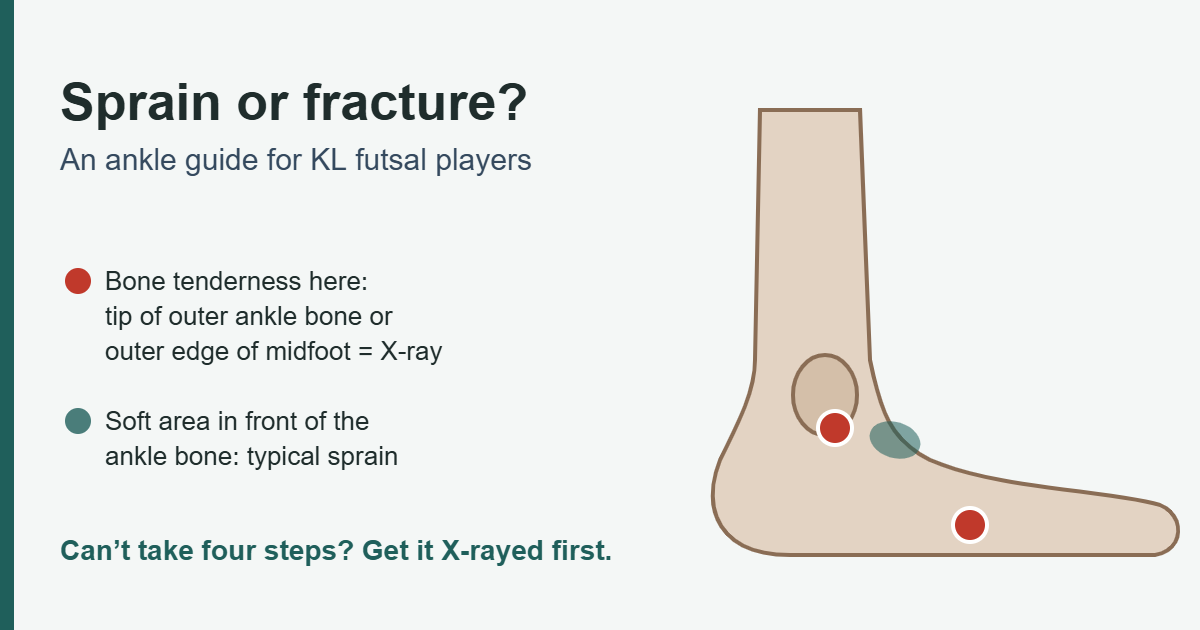
Short answer: most ankles that go over on a futsal court are sprains of the ligaments on the outside of the joint, and most settle with early, sensible movement and a few weeks of balance work. The trouble is that a fracture can feel much the same in the first hour. The quickest way to tell is the check emergency doctors use, the Ottawa ankle rules: if you cannot take four steps, or pressing on certain bony points hurts, get an X-ray before anything else. If neither applies, a fracture is unlikely.
Why ankles take the hit in Malaysian futsal
Futsal in KL is mostly played the same way: a court booked for 9pm after work, ten people who have been sitting since morning, short sprints, sharp changes of direction and a lot of contact in a small space. People land on each other’s feet, and floors in humid halls pick up sweat.
The Malaysian research points the same way. In the 2010 FELDA/FAM National Futsal League, a Universiti Malaya sports medicine team recorded 86 injuries over 141 matches. Ankle sprains were the most common diagnosis among injuries that actually kept players out, 7 of them or 39%, followed by knee sprains (Hamid et al., PLOS ONE, 2014). Those are small numbers, so read them as a pattern rather than a precise rate.
At the 2018 Malaysian Games (SUKMA), another Universiti Malaya study found futsal produced far more injuries per hour of play than eleven-a-side football, 292 against 66 per 1,000 match hours, and roughly a quarter of futsal injuries were a recurrence of an earlier one (Ahmad-Shushami and Abdul-Karim, Malaysian Orthopaedic Journal, 2020). Only about 60% of futsal injury forms were returned, so the figures are shaky, but the lesson is familiar: an ankle that was never properly rehabilitated tends to go again.
Sprain or fracture: the Ottawa ankle rules
The Ottawa ankle rules are a short checklist for deciding who needs an X-ray. A systematic review of 27 studies and more than 15,000 patients found they picked up 97.6% of fractures, so when the rules say no X-ray is needed, a fracture is rarely missed (Bachmann et al., BMJ, 2003). They rule fractures out, not in: many people who meet the criteria turn out to have a plain sprain.
You should have an X-ray if there is pain around the ankle bones and any of the following:
- You could not take four steps on it straight after the injury, and still cannot when you are checked. Limping steps count as steps.
- Pressing on the back edge or tip of the outer ankle bone, over its lowest 6 cm, hurts.
- Pressing on the back edge or tip of the inner ankle bone, over its lowest 6 cm, hurts.
- For pain in the middle of the foot: tenderness on the bony bump halfway along the outer edge of the foot (the base of the fifth metatarsal) or on the bone at the top of the inner arch (the navicular).
Pain in the soft hollow just in front of and below the outer ankle bone, where the main ligament sits, is typical of an ordinary sprain. The rules were largely developed in adults. Children’s bones have growth plates that behave differently, so with a school-age player the threshold for seeing a doctor should be lower.
| What you notice | More like a sprain | Think fracture or a more serious injury |
|---|---|---|
| Walking | Painful, but you can take four steps | Cannot take four steps |
| Where it hurts when pressed | Soft area in front of and below the outer ankle bone | Directly on the edge or tip of either ankle bone, or the outer edge of the midfoot |
| How it happened | Foot rolled inwards on landing or a quick turn | Foot planted and twisted outwards, a heavy challenge, or a fall |
| Where the pain sits | At or just below the ankle joint | Above the ankle, between the two shin bones |
| Shape of the ankle | Swollen but normal shape | Visibly deformed |
| Swelling or a pop | Unreliable, as both can swell badly | Unreliable, as both can swell badly |
The one that gets missed: the high ankle sprain
A high ankle sprain happens when the foot is planted and forced outwards, or someone lands on the back of your leg. It damages the ligaments that hold the two shin bones together just above the joint. The pain sits higher than a normal sprain and is worse when you push off or turn. It takes considerably longer to recover than an ordinary sprain, and some need surgery, so it deserves a proper assessment rather than strapping and trying again next week.
Red flags: see a doctor, not a chiropractor
- You cannot take four steps, or the Ottawa checks above are positive
- The ankle looks deformed, a bone is pressing against the skin, or there is an open wound
- The foot is cold, pale, numb or tingling
- A kick-like snap at the back of the heel, and you cannot rise onto your toes
- Severe pain that keeps getting worse over hours despite rest and elevation, with tight, tense swelling
- Calf pain with swelling and warmth in the days or weeks afterwards, particularly after a period in a cast or boot
- Fever with a hot, swollen joint
Where to go in KL. For deformity, an open wound or a cold foot, go to an emergency department the same night. Hospital Kuala Lumpur on Jalan Pahang has a 24-hour emergency department. If you cannot take four steps but are otherwise stable, get an X-ray that day or the next. For Malaysian citizens, outpatient consultations at government clinics and hospitals cost RM1 to RM5, and your local Klinik Kesihatan is the usual route to a hospital specialist clinic, which generally needs a referral letter (Malay Mail, April 2026). Private clinics and hospitals can also X-ray you, at private rates. Either way, answer the fracture question before booking hands-on treatment.
The first few days
For an ordinary sprain, the current approach is to protect the ankle for a day or three, keep it raised when you can, use compression for the swelling, and then start walking on it as pain allows. Longer periods of complete rest tend to leave the joint stiffer, and current guidance favours letting pain guide a gradual return to load (Dubois and Esculier, British Journal of Sports Medicine, 2020). Ice may ease pain, but there is little evidence it speeds healing. Strapping it tightly and finishing the match does not help.
What chiropractic care can and cannot do
Chiropractic care does not heal a torn ligament or a broken bone, and nobody should suggest it does. A suspected fracture needs imaging and medical care, not manipulation.
Where hands-on care can help is after the acute stage. A sprained ankle often loses its forward bend (dorsiflexion), the movement you need to decelerate and turn. Joint mobilisation or a chiropractic adjustment can help restore that, and sports massage can ease a calf that has tightened up while you limped around. The evidence for manual therapy here is modest and mostly short-term, so treat it as a way to make the exercise possible, not a substitute for it.
The exercise is what prevents the next sprain. In a Dutch trial of 522 athletes who had recently sprained an ankle, an eight-week unsupervised home balance programme cut self-reported recurrences from 33% to 22% over a year, a 35% reduction in risk; nine athletes needed to do the programme to prevent one recurrence (Hupperets et al., BMJ, 2009). If your recovery will be mostly exercise prescription, a physiotherapist may suit you better. The two professions are regulated separately in Malaysia: chiropractic is one of the recognised practice areas under the Traditional and Complementary Medicine Act 2016 (Act 775), and physiotherapy falls under the Allied Health Professions Act 2016 (Act 774). The differences are set out in chiropractor versus physiotherapist in Malaysia.
At Chiropractic House, at Suria @ North Kiara off Jalan Kuching, a first session is RM250 to RM410 depending on what the assessment and treatment involve, and follow-up sessions cost less. It is a short drive from Segambut, Dutamas, Sri Hartamas and Mont Kiara. We are a cash-pay clinic and do not bill insurers directly, but we issue receipts and clinical documentation if you want to claim yourself. The practicalities are covered in chiropractic insurance coverage in Malaysia.
Getting back on court
Go by what the ankle can do, not by the calendar. Before a full game, you should be able to walk and jog without a limp, hop repeatedly on the injured leg without pain, balance on it about as well as on the other side, and sprint, stop and cut in both directions at full speed. If a school-age player is involved, get a doctor’s clearance for anything beyond a mild sprain.
Frequently asked questions
Do I need an X-ray for every sprained ankle?
No. If you can take four steps and there is no tenderness on the specific bony points described above, an X-ray is usually unnecessary in adults. If either check is positive, get one.
My ankle keeps rolling. Why?
After a sprain, the ankle’s balance reactions are often slower and the joint may be stiffer, which makes the next sprain more likely. Balance and strength training usually helps, even years later. If it keeps giving way despite that, ask for an orthopaedic opinion. The same pattern is common on the badminton court, covered in badminton injuries in Malaysia.
Should I strap or tape it?
Tape or a brace may give some support in the first months back, and many players find it reassuring. It does not replace the balance work, and taping an injury you have not had assessed so you can finish a game is a bad idea.
Will a chiropractor manipulate a freshly sprained ankle?
Not while a fracture has not been ruled out, and not usually in the first few painful days. Manual work on the ankle, if it is used at all, comes later, when stiffness rather than injury is the main problem.
If your ankle has been sore or unreliable for more than a few weeks, or you have quietly been playing around it, it is worth having it assessed. You can get in touch with the clinic here. If any of the red flags apply, see a doctor first.
Medical disclaimer: this article is general information, not a diagnosis or a treatment plan. Ankle injuries have several possible causes and some need medical rather than manual care. Please see a qualified healthcare professional about your own symptoms, and seek urgent medical care if any of the red flags described above apply to you.
Written by Eugene Gan, Chiropractor, Bachelor of Science (Hons) Chiropractic, accredited by the Council on Chiropractic Education Australasia (CCEA). Chiropractic House, Suria @ North Kiara, off Jalan Kuching, Kuala Lumpur.


